 Share:

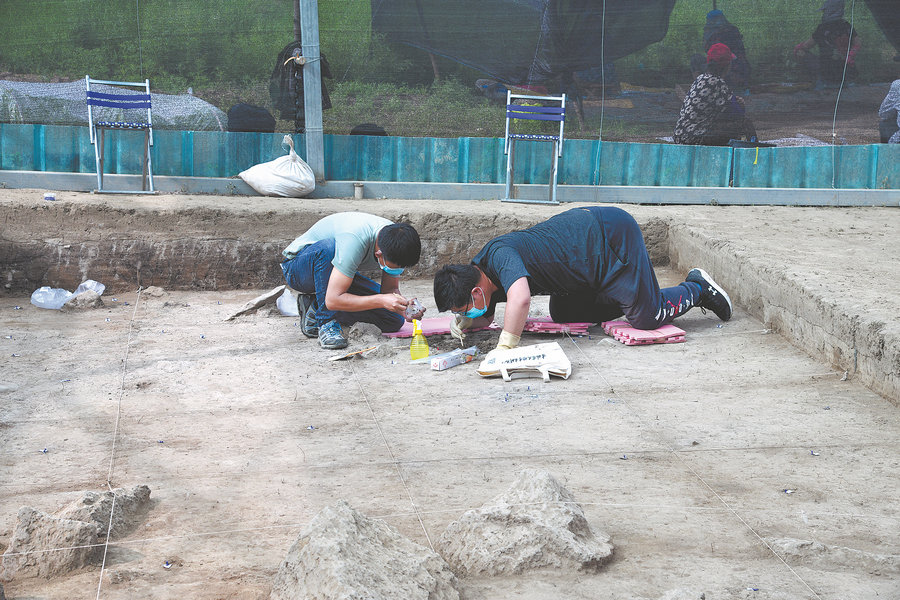
Technicians clean the Dadong site in Helong. [Photo provided to China Daily]
"In the earlier phase at Dadong, people mainly used obsidian collected from nearby riverbeds. Later, they began sourcing the material from primary volcanic deposits, about 200 km from the site. This suggests their activity range expanded significantly," says Li.
Xu notes that this growing mobility fits into a broader regional pattern. Earlier studies by researchers in China and abroad have shown that obsidian from the Changbai Mountain area reached as far as present-day Shanxi province around 40,000 years ago, and also appeared at numerous sites on the Korean Peninsula, suggesting a circulation network of this special material across Northeast Asia.
"How did the material travel over such long distances? It is possible that it moved through multiple exchanges between different groups of people," says Xu.
"Our work actually plays a very significant role in understanding the entire obsidian exchange and circulation network across Northeast Asia, with the Changbai Mountain region at its core," he says, adding that international cooperation is underway to gain more understanding of the overall scenario.
Wang Youping, an archaeology professor at Peking University, says the Paleolithic industry dominated by obsidian lithic materials in this area is an extremely rare discovery among Paleolithic sites in China. At the same time, several findings are challenging long-held assumptions. At the Dadong site, archaeologists uncovered polished stone tools, which are often believed to be a sign of Neolithic human activities, dating back roughly 27,000 years. The discovery may offer new clues about how and when polishing techniques first emerged.


 京公网安备
11010802027341号
京公网安备
11010802027341号