 Share:

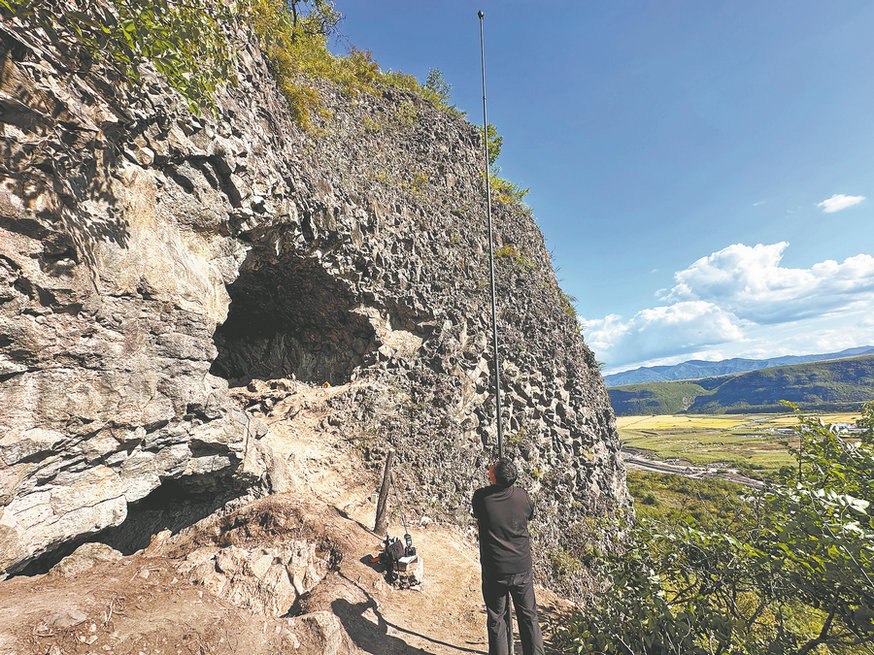
A researcher measures the size of a cave for mapping at the Shangtiandong site in Helong, Jilin province. [Photo provided to China Daily]
Excavations at five major sites — Dadong, Jidi and Shangtiandong in Helong, Fenglin in Baishan, and Xianrendong in Huadian — have yielded rich collections of stone tools and animal fossils, Xu says. Taken together, these sites establish a cultural sequence spanning roughly 220,000 to 15,000 years ago.
For example, Xianrendong pushes the timeline of human activity in the region to about 220,000 years ago. Later sites, including Dadong (50,000-15,000 years ago) and Fenglin (24,000-17,000 years ago), document the emergence and refinement of microblade techniques from around 28,000 years ago. Shangtiandong captures a transitional phase between the Paleolithic and Neolithic eras, from 15,000 years ago to the Bronze Age, with finds that include bones likely used in early ritual practices.
"Therefore, we have generally built a cultural sequence of this area, so that we now know the earliest human activity traces, what stone tools ancient people used at different times, and what cultural characteristics were demonstrated in each phase," says Xu.
Located in Northeast Asia, this area was a key position in human evolution and migration during the prehistoric era. "Geographically, the region sits at a natural crossroads," says Xu. "To the east lies the Russian Far East, to the south, it links the Korean Peninsula. To the west, it can connect through western Liaoning province or western Jilin to the northern grasslands and North China."
Nature itself played a decisive role in shaping life here. Frequent volcanic activity produced abundant obsidian, an ideal material for toolmaking due to its hardness, uniform structure and durability. At the same time, volcanic ash enriched the soil, supporting diverse plant life and attracting animals. Together, these factors created an environment rich in resources despite harsh climatic conditions.
Some of the sites contain evidence of people who lived during the Last Glacial Maximum (approximately 26,500 to 19,000 years ago, when ice sheets and glaciers reached their greatest extent). Archaeologists suggest the appearance of microblade tools helped communities adapt to the environment.
"We believe people in the Paleolithic period lived a hunter-gatherer lifestyle. During colder phases, when resources became scarce, they would have expanded their range to secure what they needed. The microblade tools were easy to carry, so they could satisfy people's need to migrate long distances," says Xu.
"With a microblade core and a stone hammer, people could produce a steady supply of tools. These could be used as hunting implements, significantly improving their chances of survival," he adds.
Xu also notes that micro-trace analysis suggests some tools were versatile, allowing people to carry the minimum number to meet their needs during migration.
More importantly, they have conducted detailed research on the obsidian found at the sites. Xu says that since this material has varying internal chemical components when formed by volcanic eruptions in different periods or regions, microanalysis can trace its source.
"At Dadong, we've found obsidian from multiple origins. Much of it comes from areas around Tianchi Lake on Changbai Mountain and nearby regions, but a small portion can be traced to the Russian Far East. That tells us people were able to obtain materials from considerable distances," says Xu.
Li Feng, a researcher at the School of Archaeology and Museology at Peking University who also takes part in the program, says that in their source-tracing studies, they discovered some volcanic eruption sites where obsidian deposits were exposed, while other rocks were eroded by rivers and deposited in riverbeds.


 京公网安备
11010802027341号
京公网安备
11010802027341号