 Share:

Editor's note: Xizang, as the core part of the Qinghai-Tibet Plateau which is dubbed the "Roof of the World" and the "Water Tower of Asia," is a vital ecological security barrier for China and Asia at large. Its ecological conservation is paramount for the global climate response and sustainable development.
The autonomous region has made significant progress in environmental conservation and restoration, as well as the building of a national ecological civilization highland, thanks to its strengthened protection and systematic management of eco-systems including rivers, lakes, wetlands, forests, grasslands, mountains, glaciers and sandy lands, alongside a multi-pronged approach to advance green development, scientific afforestation, biodiversity and sustainability.
With a commitment to promoting harmony between humans and nature, Xizang has designated more than 50% of its land within its ecological protection red lines, and established 97 protected areas with a combined area of 434,000 square kilometers, accounting for 36% of its total land area. According to the second survey of terrestrial wild animals, there are 1,072 terrestrial wild vertebrate species and 246 wild animal species under special state protection in the region. A total of 7,504 species of vascular plants have been recorded, of which 1,075 are endemic to the region, and 169 species of wild plants are under special state protection.
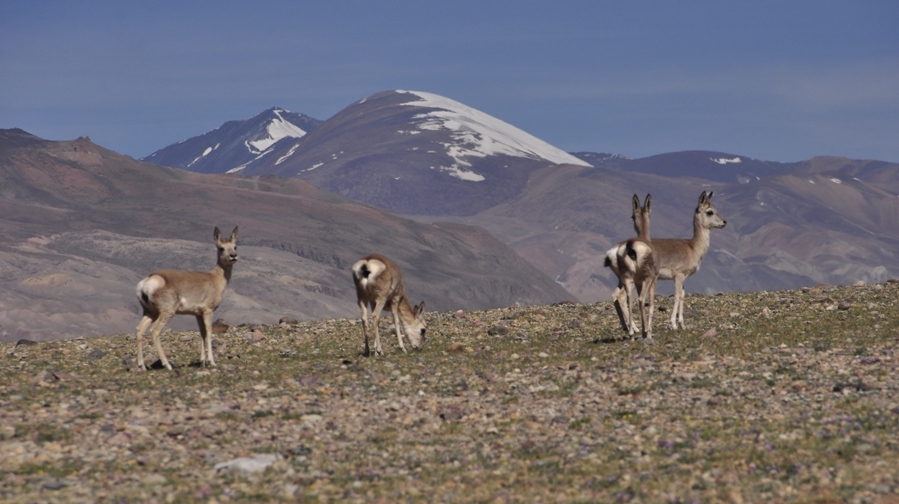
The region is a haven for rare wildlife, including Tibetan antelopes, wild yaks, Tibetan wild donkeys, black-necked cranes, Tibetan brown bears and snow leopards. The population of Tibetan antelopes has risen from around 70,000 in the 1990s to over 300,000, wild yaks from under 10,000 to more than 20,000, and black-necked cranes from under 3,000 to more than 10,000, according to official data. The Tibetan red deer, once considered extinct, now has a population in excess of 800.
Data shows that from 2020 to 2025, Xizang's forest coverage increased from 12.31% to 12.54%, and is expected to reach 12.61% or above by 2030; its comprehensive grassland vegetation coverage rose from 47% to 50%, and will remain above 50% by 2030; and the soil and water conservation rate (excluding freeze-thaw erosion) has already hit 92.2%.
Here, China.org.cn presents a selection of photographs showcasing Xizang's ecological beauty and biological diversity.
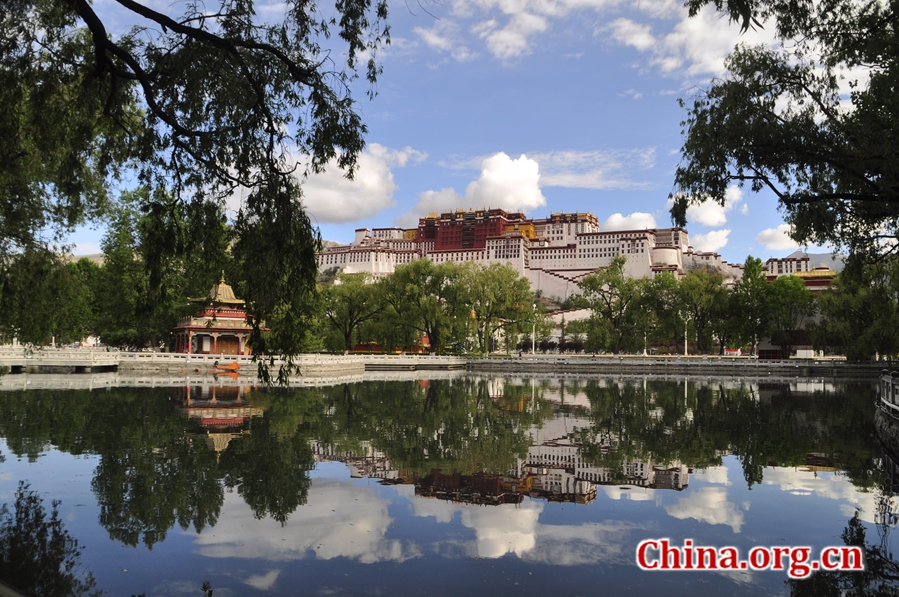
The Potala Palace, reflected in a tranquil pond in a nearby park, in the center of Lhasa, Xizang Autonomous Region, June 6, 2025. [Photo by Zhang Junmian/China.org.cn]


 京公网安备
11010802027341号
京公网安备
11010802027341号