


 Share:

In a historic milestone for mathematics, two Chinese nationals Wang Hong and Deng Yu were named recipients of the 2026 Fields Medal on July 23 at the International Congress of Mathematicians in Philadelphia, the United States.
The award, established in 1936 and presented every four years to mathematicians under the age of 40, marked the first time Chinese nationals have received the prestigious honor.
Joining Wang and Deng as 2026 recipients were American mathematician John Pardon and Canadian mathematician Jacob Tsimerman.
Following the announcement, French President Emmanuel Macron personally called Wang Hong, a mathematician and professor at New York University (NYU) and the Institut des Hautes Etudes Scientifiques (IHES) in France, to offer his congratulations.
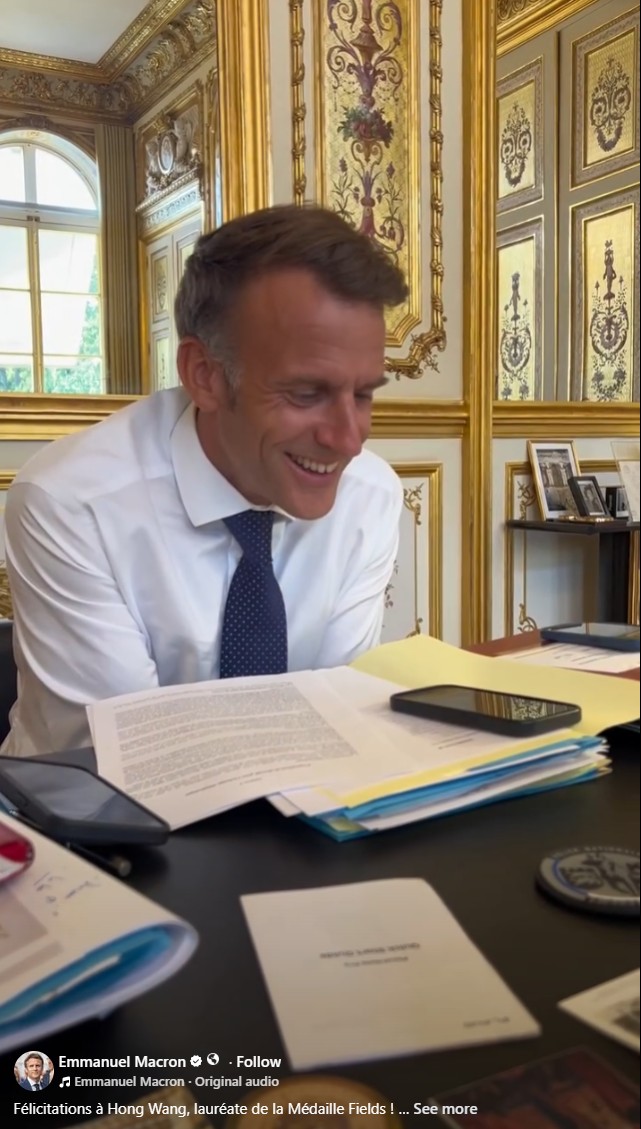
A screenshot of a video of French President Emmanuel Macron's phone call to mathematician Wang Hong congratulating her on winning the Fields Medal, posted on social media on July 23, 2026. [Photo/China.org.cn]
Macron praised Wang Hong's achievement and said that he, along with French scholars, was proud of the recognition. He also shared his congratulations on social media, describing Wang as someone who represents the excellence of French research and education. Wang Hong received part of her academic training in France and is currently a faculty member at IHES.
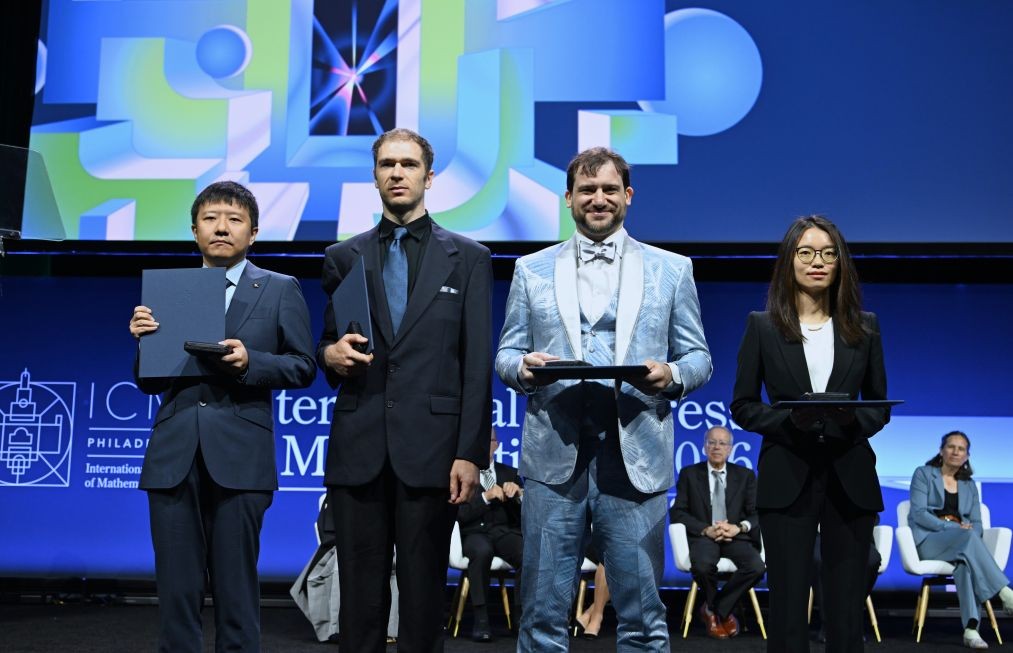
(Left to right) Fields Medal winners Deng Yu, John Pardon, Jacob Tsimerman and Wang Hong pose for a group photograph at the 2026 International Congress of Mathematicians in Philadelphia, the United States, July 23, 2026. [Photo/Xinhua]
For China's mathematical community, the recognition carries special significance. It represents not only the achievements of two young scholars, but also provides a window into the long-term development of China's science and innovation ecosystem, highlighting the accumulated strength behind the country's efforts in education, research and talent cultivation.
Wang Hong, born in 1991 in Guilin, Guangxi Zhuang autonomous region, entered Peking University in 2007, initially studying earth and space sciences before transferring to the School of Mathematical Sciences. She later earned a master's degree from Paris-Sud University and a PhD from the Massachusetts Institute of Technology.
Deng Yu is a professor at the University of Chicago. He was born in 1989 in Shenzhen, Guangdong province, and entered Peking University's School of Mathematical Sciences in 2007 after winning a gold medal at the International Mathematical Olympiad. He later transferred to the Massachusetts Institute of Technology and received his PhD from Princeton University in 2015.
While Wang and Deng pursued distinct research trajectories internationally, both received their foundational academic training in China before advancing to top international universities and research institutions. Their simultaneous success marks a milestone, reflecting decades of effort in strengthening mathematics education and developing scientific talent.
Behind the emergence of world-class mathematicians is often a comprehensive and interconnected education system. From identifying students' scientific potential at an early stage, to providing rigorous university-level training, and then supporting young researchers through advanced research platforms, the cultivation of top scientific talent requires a continuous pathway linking basic education, higher education and frontier research.
In recent years, China has placed greater emphasis on fundamental research and the development of young scientific talent. Increased investment, improved support mechanisms and a growing recognition of the long-term nature of basic research have created a more supportive environment for scholars to pursue challenging questions that may not yield immediate practical results.
The development of mathematics, like many other fields of fundamental science, depends heavily on open international exchange. Major breakthroughs rarely come from isolated efforts. Chinese mathematicians have increasingly participated in global academic networks, engaging in international collaboration while contributing their own ideas and perspectives. At the same time, China has continued to welcome researchers from around the world to participate in scientific exchange and cooperation.
Over the past decade, China has significantly increased support for basic research. According to official data, basic research funding rose from almost 50 billion yuan in 2012 to nearly 280 billion yuan in 2025, reflecting both increased scale and a stronger focus on long-term innovation.
While the Fields Medal is a recognition of individual excellence, the success of Wang Hong and Deng Yu also offer insight into the broader forces behind scientific progress. Their success is the result of multiple factors coming together: sustained investment in research, a maturing academic environment and the gradual formation of a talent pipeline capable of supporting long-term exploration.
As science becomes increasingly interconnected across borders, the stories of Wang Hong and Deng Yu demonstrate how talent cultivated through different educational and research environments can contribute to the advancement of global knowledge. Their achievements are not only milestones for mathematics, but also examples of how sustained educational development and international scientific collaboration can create new possibilities for discovery.


 京公网安备
11010802027341号
京公网安备
11010802027341号