 Share:

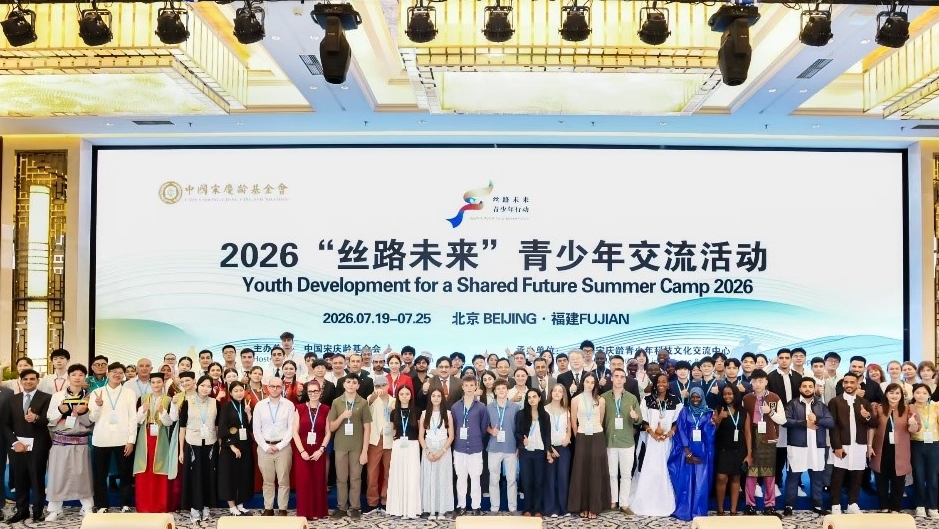
The opening ceremony of the "Youth Development for a Shared Future Summer Camp 2026" was held in Beijing on July 20, bringing together young people from 16 countries, including Turkmenistan, Montenegro, Gambia, Russia, Spain, Malaysia and Pakistan, to promote friendship, mutual understanding and shared development.
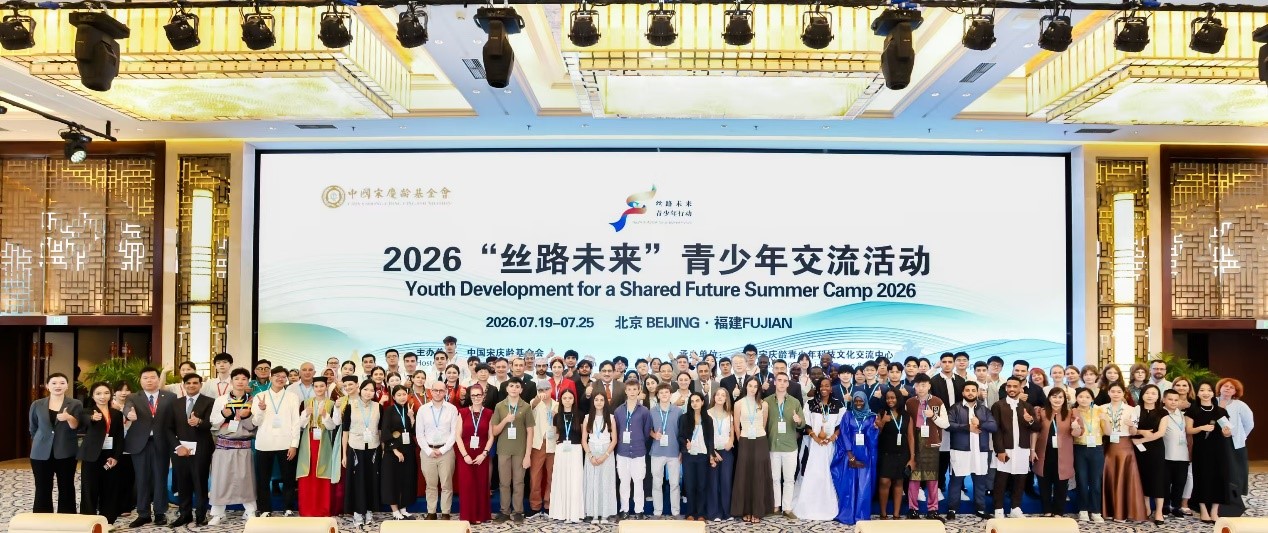
Participants in the "Youth Development for a Shared Future Summer Camp 2026" pose for a group photo at the opening ceremony in Beijing, July 20, 2026. [Photo courtesy of CSCLF]
Organized by China Soong Ching Ling Foundation (CSCLF), the weeklong event aims to serve as a vibrant platform for youth from across the globe to exchange knowledge, bridge cultural divides and plant the seeds for future international cooperation. CSCLF Vice Chairperson Zhang Jiming, alongside a gathering of distinguished guests and international delegates, attended the opening ceremony.
Welcoming the participants, Zhang emphasized the role of young people as vital builders of a shared future and bridge-builders for international friendship. He noted that the camp provides a unique historical and cultural setting for young people to experience China's rich heritage and modern development firsthand, while deepening mutual respect. He encouraged participants to interact, learn from one another and contribute their youth and wisdom to global peace and sustainable development.
Addressing the ceremony, Maya Gayypova, a representative of the delegation from Turkmenistan, expressed high appreciation for the initiative, noting that the camp will become "not only a platform for exchanging knowledge and experience but also a place where lasting friendships are formed, new ideas emerge and future international cooperation begins."
Gayypova highlighted the growing humanitarian partnership between Turkmenistan and China, specifically pointing to the expanding cooperation between the CSCLF and the Gurbanguly Berdimuhamedov Charity Fund for Providing Assistance to Children in Need of Guardianship. She underscored that the partnership "contributes to educating young people in the spirit of peace, mutual respect, solidarity and shared responsibility for our common future."
Elena Golubović, a young flutist from Montenegro representing the European participants, shared her passion for cultural connection through the shared language of art. "Music is a universal language. Even when people do not speak the same language or come from the same culture, they can still understand one another through melody, rhythm and emotion," she said.
Expressing her eagerness to experience China beyond textbooks and the internet, Golubović noted that the Belt and Road Initiative (BRI) represents a modern vision of connection and cooperation. "For me, this program is not only a journey to a new country. It is an opportunity to become more open-minded, independent, curious and connected to the world," she added, expressing her hope to build lasting friendships and represent Montenegrin culture during the camp.
Sohna Bittaye, a biology student from the University of the Gambia, highlighted the historical resonance of youth exchange along the ancient Silk Road, describing it as an enduring bridge for global friendship.
"The Silk Road was much more than a trade route. It became a bridge connecting different civilizations," Bittaye said, adding that China continues this spirit through the BRI by fostering educational exchanges and scientific cooperation. "It provides opportunities for students, researchers and young people from different countries to learn from one another and build lasting friendships."
Running from July 19-25, the seven-day camp features a rich itinerary blending historical exploration and modern technological experiences in Beijing and Fujian province. Participants are scheduled to visit cultural landmarks, including the Great Wall and the Palace Museum, tour high-tech enterprises and eco-development zones, and engage in youth dialogues designed to foster deeper cross-cultural understanding.


 京公网安备
11010802027341号
京公网安备
11010802027341号