 Share:

Editor's Note: This June, Thai international student in China, Jachi Nawa, visited Quanzhou and Xing'an in Guilin. Visiting villages, tea factories, and food processing parks, she documented China's rural revitalization efforts through the eyes of an overseas youth while reflecting on agricultural development and rural cooperation between China and Thailand.
People often say, "Guilin's landscape is unrivaled under heaven". Before arriving in Guangxi, my deepest impression of Guilin came from photographs of its celebrated mountains and rivers. But as I came to Guilin through the "Together on the Long March" project, I realized that beyond the beauty of its landscape, there is another story waiting to be understood, a story of how the countryside has developed and changed.
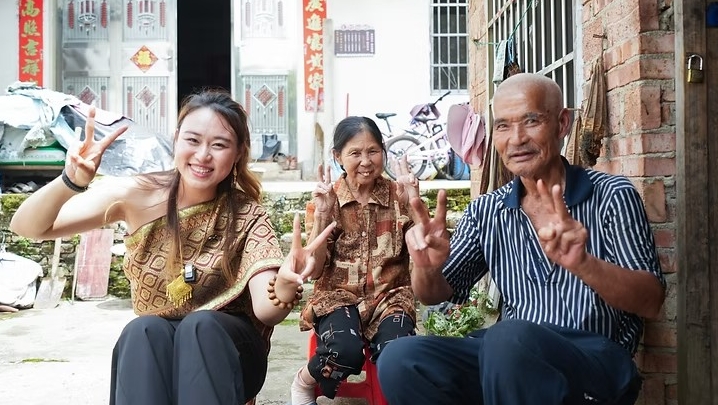
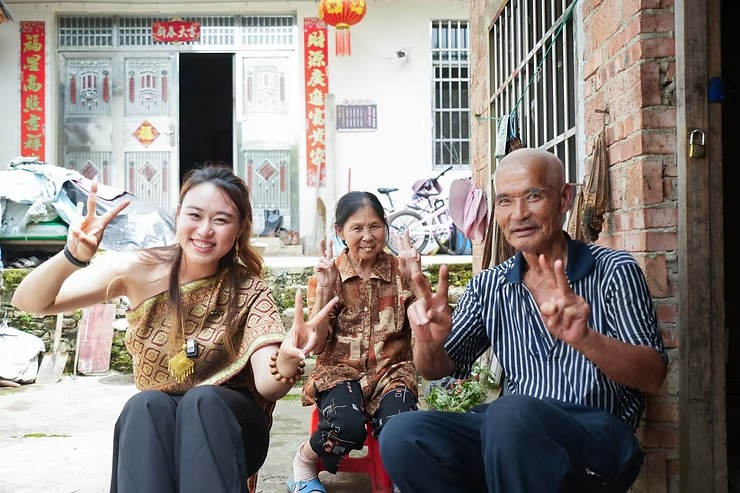
In Maozhushan Village, I spoke with an elderly local woman about the village's past. She told me that the scenery here had always been beautiful, but life was not always easy. The village was enclosed by mountains, and transport was difficult. To leave the village, people had to walk a long way along mountain paths. Goods from outside were hard to bring in, and the produce grown by villagers was hard to sell. There were few ways to earn a living. Many people might have thought that the landscape was the village's greatest treasure. Yet for those who lived among these mountains and rivers, beauty alone did not immediately bring a better life. In some ways, the mountains were barriers, standing between the village and the outside world. As I listened to her memories, I began to see why rural revitalization means so much to villages like this.
But Maozhushan Village today tells a different story. The roads are wide and clean. The village is better connected, its infrastructure much improved, and its environment neat and welcoming. What moved me most was to see how the grapes grown by local villagers have become a distinctive local industry. They are sold in local markets and, through e-commerce platforms, sent to customers across the country. The mountains that once made life difficult have now become a source of opportunity, drawing visitors and supporting distinctive local industry. The mountains and rivers are still there, but the village has been renewed in remarkable ways.
As the journey unfolded and I came to know this region more deeply, I began to understand that the transformation of Maozhushan Village was not happening on its own. In the past few days, we visited Liudong Tea Factory, Xiangshan Liquor Eco-Park, and Milanxiang Food Co., Ltd. At first glance, these places seemed quite separate from one another, ranging from a village and a tea factory to a liquor factory and a food-processing company. But as I listened, observed, and learned more, I realized that they were all telling the same story of how the growth of local industries can open up new possibilities for rural life.
In Liudong Tea Factory, I saw tradition and modernity meeting in the making of tea. In Xiangshan Liquor Eco-Park, I saw how a local specialty industry can become a driving force for the local economy. And in Milanxiang Food Co., Ltd., I saw yet another way to unlock the value of agricultural products. Local produce is no longer treated merely as raw material to be sold at the first stage. Through processing, packaging, and branding, it gains greater added value and becomes part of a more complete industrial chain. It reminded me of the idea of "value creation", a concept often mentioned in finance. This kind of development model, I felt, creates value not only for products, but also for people. It brings more jobs, more possibilities, and more choices for young people who may wish to stay in their hometowns and build their lives there.
During the visit, I was especially struck by something the head of the tea factory said. "Machines are not here to replace people. They are here to raise productivity and create more opportunities." These words stayed with me. It made me understand more deeply that modernization and rural development do not stand against each other. They can move forward together, each giving strength to the other.
If industry gives the countryside new strength from within, e-commerce gives it a bridge to the world beyond. In the past, limited roads and limited information often meant limited markets. Many agricultural products could only be sold nearby, and villages found it difficult to reach buyers elsewhere. But today, through the internet and e-commerce platforms, even a mountain village can send its products across the country and, eventually, to the world. In Maozhushan Village, grapes are sold nationwide through livestreaming. Seeing this, I was truly struck by the vitality of China's e-commerce development.
Along the way, I also found myself thinking about the future of cooperation between China and Thailand. Both countries are blessed with rich agricultural resources, and both have experience worth sharing in agricultural modernization, food processing, and e-commerce. In recent years, more Thai fruits have made their way into the Chinese market, while China's experience in developing e-commerce and building industrial chains has offered new ideas for agricultural development in Thailand. I believe that in the years ahead, China and Thailand can strengthen exchanges and cooperation even further. Together, the two countries can explore new models for upgrading agricultural industries and promoting rural development, help more high-quality produce enter the global market, and move toward mutual benefit, win-win cooperation, and shared growth.
This journey through Guangxi helped me see that rural revitalization is not an abstract development idea written on paper. It is a living change happening in villages. It has changed how villagers live and how the countryside speaks to the world. Villages once blocked by mountains are now connected to broader horizons through industry and the internet. Places that once depended mainly on traditional farming are now growing featured industries, building their own brands, and opening new doors through e-commerce. In Maozhushan Village, I saw China's rural revitalization come alive. I also came to understand that China's approach to rural revitalization is about helping each place discover where it belongs and what makes it distinctive. It is about finding the development path best suited to local realities. True development does not ask every village to become the same. It gives each village the chance to use its own strengths, shape its own identity, and create its own future.


 京公网安备
11010802027341号
京公网安备
11010802027341号