 Share:

Editor's Note: This June, Thai international student in China, Jachi Nawa, visited Quanzhou and Xing'an in Guilin. Through visits to the Xiangjiang Campaign Memorial Hall, the Laoshanjie Long March trail, and the Red Army Hall, she revisited the history of the Long March and experienced the enduring spirit it represents. From the perspective of an overseas young visitor, she recorded her observations and reflections in this travel journal, sharing a cross-cultural understanding of this important chapter of history.
"What was I doing at the age of fourteen?" That question kept echoing in my heart as I left the Memorial Hall of the Battle of the Xiangjiang River during the Red Army's Long March. At fourteen, I was probably complaining about meals that did not suit my appetite, sulking over a toy I could not have, or brooding over little things that were, in truth, of no consequence. But inside the memorial hall, as I came to know the stories of the Long March, I suddenly realized that many Red Army soldiers of almost the same age had already left their families, stepped onto the battlefield, crossed mountain after mountain, and begun the Long March into the unknown.
"For three years, no one drank from the Xiangjiang River; for ten years, no one ate the fish from its waters." Since coming to Guangxi, I have heard this saying many times. The first time I heard it, I wondered what kind of past could be so heavy that people would remember it in such a way. Later, when I learned the whole course of the Battle of the Xiangjiang River and stood on the riverbank myself, I finally understood. The first time I stood beside the Xiangjiang River, I found myself unable to leave. My heart was full of emotions I could hardly name, a mixture of shock, grief, sorrow, and deep reverence. Tears hovered in my eyes. It was as if I had been carried across the years and had seen the Red Army soldiers by the river, fighting with everything they had to cover the main force and to defend the hope of revolution. I seemed to see the Xiangjiang River once colored by the sacrifice of countless soldiers. I seemed to feel the heartbreak of turning back and seeing a vast red shadow behind them. Those who gave their lives there could have chosen only to protect themselves. Instead, for the country and for the people, they went forward without turning back. What they left behind was more than the color once reflected in the Xiangjiang River. It was a red that would never fade from the hearts of generations of Chinese people. It was a faith that took root, deeply and firmly, in this land.
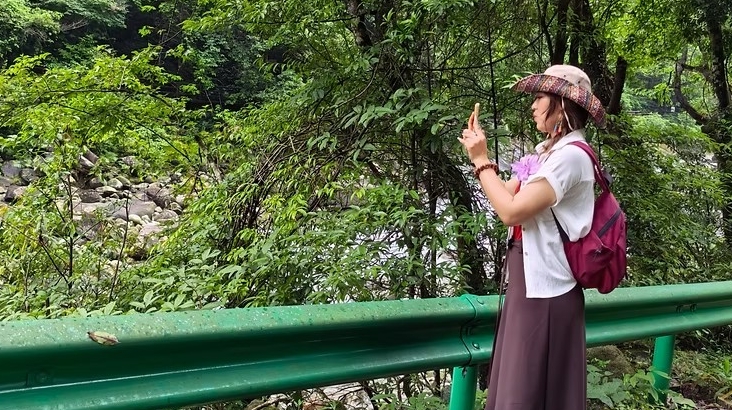
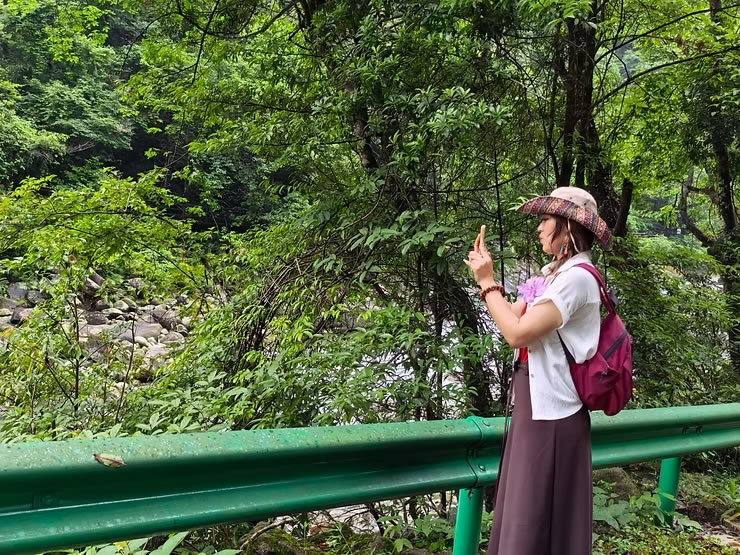
I can still see the day we walked the Laoshanjie trail, once taken by the Red Army. Rain had just fallen, and the mountain forest was heavy with moisture. The trail today has been paved into a flat cement road, sparing us the mud and perilous climbs that the Red Army once faced. Yet after the rain, even this modern road was slick underfoot. My friend and I walked with extra caution, sometimes steadying each other as we moved forward. It was almost impossible to imagine how those soldiers had crossed this mountain in those days. They had heavy packs and weapons on their backs, worn straw sandals on their feet, wind and rain against their faces, and hunger and exhaustion in their bodies. The mountain paths were narrow and steep, but they kept going. However difficult the conditions, they bore them with determination, crossing one mountain after another without ever halting their steps. We walked the same road, but what lay before our eyes was the beauty of the landscape. What lay before their eyes, in those years, was a road of danger and hardship. In their hearts, there was only one thought, which is to keep moving, to break through, and to carry on. In that instant, I felt more deeply than ever how blessed we are today.
Our final stop was the Red Army Hall. There, a young guide in a red scarf, still only in his teens, told us the story of the Battle of the Xiangjiang River. He spoke with ease, confidence, and quiet strength. Watching him, I felt that the people here have never forgotten this history. The red spark has never gone out. It has been passed from one generation to the next, quietly yet steadfastly, still glowing, still lighting the way forward.
I feel deeply honored that the "Together on the Long March" project brought me to Guilin and gave me the chance to listen to the stories held by this land. Only now do I truly understand why the Long March continues to be remembered, celebrated, and passed from one generation of Chinese people to the next. It is not merely because of the vast distances it covered or the extraordinary hardships endured along the way, but because it carries a strength that refuses to yield. To walk the Long March route again is more than to follow a path through history. It is to draw closer to a spirit, to understand a chapter of the past, and to glimpse the journey of a nation. In the days to come, I hope to share with more friends what I saw, what I heard, what I felt, and what this journey has left in my heart.


 京公网安备
11010802027341号
京公网安备
11010802027341号