Share:

The Shanghai International Film Festival (SIFF) this year launched AI Backlot, a new unit exploring AI visual production and the possibilities it offers for the film industry.
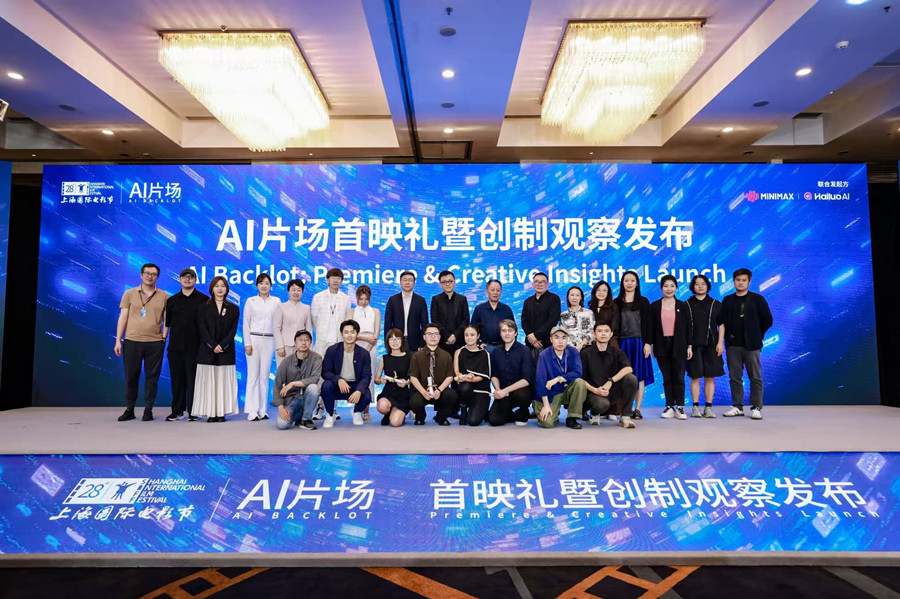
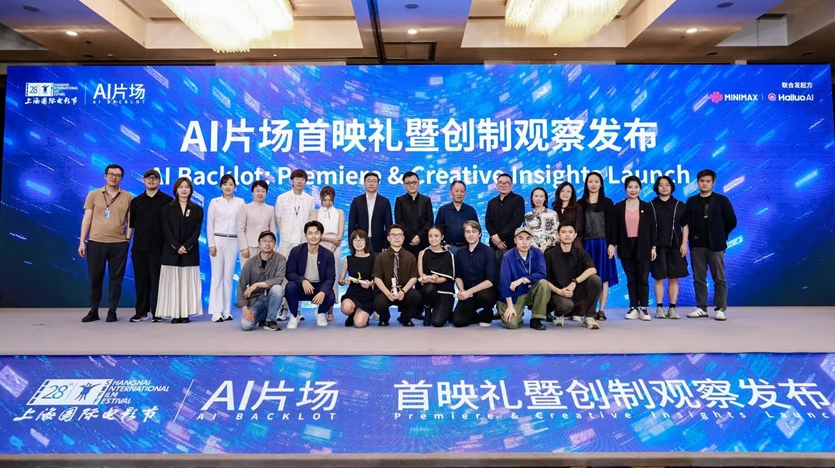
Filmmakers, jurors and festival organizers gather at an AI Backlot event during the Shanghai International Film Festival, June 14, 2026. [Photo courtesy of the SIFF Organizing Committee]
"Film has always had a deep relationship with technology," director Huang Jianxin said at an AI Backlot event. "From cameras to digital effects, every technological change transforms cinema. Many years ago, I made a film with an absurd story to imagine the relationship between humans and intelligent machines. Today, machines have actually entered the film set and become something that creators face every day."
He added, "My attitude is simple: don't deify it, and don't be afraid of it. It has problems and limitations, but it's already here and changing fast. We need to actively understand it."
One of AI's most tangible effects is putting filmmaking within reach of almost anyone. This year's festival explored that shift, organizers said, as Shanghai bids to become a center for the film industry's digital transformation.
The festival's program centered on how film and AI creators work together, focusing on creative methodologies, collaboration workflows and industry logic rather than finished products alone.
Its core section, "Hyperimage Peaking Challenge," paired film directors with AI creators to complete a full production cycle, sharing prompts, workflows and lessons to map what is — and isn't — currently possible in AI film production.
The program drew around 500 applicants from seven countries and regions, with creators born in the 1990s and 2000s making up more than 60%. Four collaborative teams were selected and given one month to produce short films, which they showcased June 14 and 15at the Shanghai Film Art Center alongside their workflows, raw materials and discarded footage. Visitors could also try AI visual creation tools at interactive zones.
Huang led the initiative, supported by an executive producer team of filmmakers and industry experts. The School of Theater, Film and Television at the Communication University of China provided academic oversight.
"Through this open creative site, the SIFF hopes to create an observable, discussable and accumulable industry sample, providing a real reference for the film and television industry to understand AI, use AI and evaluate AI," said Tong Ying, deputy director of the Shanghai International Film and TV Festival Center.
"Even more encouraging, this exploration has already begun to generate real industry connections," Tong said. "Five finalist teams have expressed interest in starting businesses in Shanghai, and four collaborative teams are in talks with commercial projects."
"Keeping up with technological development, nurturing new creative forces and driving industrial innovation are also key missions of the SIFF," Tong said.
Quji Xiaojiang, deputy general manager of film and television production of Bona Film Group, emphasized that AI needed to move beyond general-purpose models toward specialized tools built for the film industry, an area she said remained largely undeveloped.
Huang said the unit had already revealed a broader shift: "In the past, the booths were all big film companies. Now there are many individual creators. New quality productive forces don't necessarily grow out of big companies — they can emerge from very small creative units. The stronger the tools become, the more important human judgment becomes."
He added that AI would not replace creative instinct. "It can generate images, improve efficiency and expand imagination, but in the end, whether to keep a frame or whether a character has emotion still depends on the creator."


 京公网安备
11010802027341号
京公网安备
11010802027341号