 Share:

"I grew a tomato in May 2026. Consider this my official announcement."
The tongue-in-cheek post, accompanied by a photo of a tomato barely larger than a goji berry, quickly went viral on Chinese social media, resonating with thousands of users who eagerly shared photographs of their own cucumbers, peppers, strawberries, potatoes and radishes growing on balconies and rooftops across the country.
Whether the harvest is abundant or modest seems almost beside the point. For many people in China, the bond with the land appears remarkably resilient. Decades of rapid urbanization may have transformed skylines, but they have not entirely severed people's connection to growing things.
If you open RedNote, the Chinese social media platform that has gained international attention ever since last year's wave of "TikTok refugees," you will find countless videos of city dwellers, many of whom are, surprisingly, young people, cultivating fruits and vegetables in the most unlikely places. On apartment balconies, tomatoes ripen in pots, cups and even milk tea takeaway bags. Meanwhile, rooftop spaces have been transformed, with cucumber vines climbing simple trellises from foam boxes, set against a backdrop of high-rise buildings.
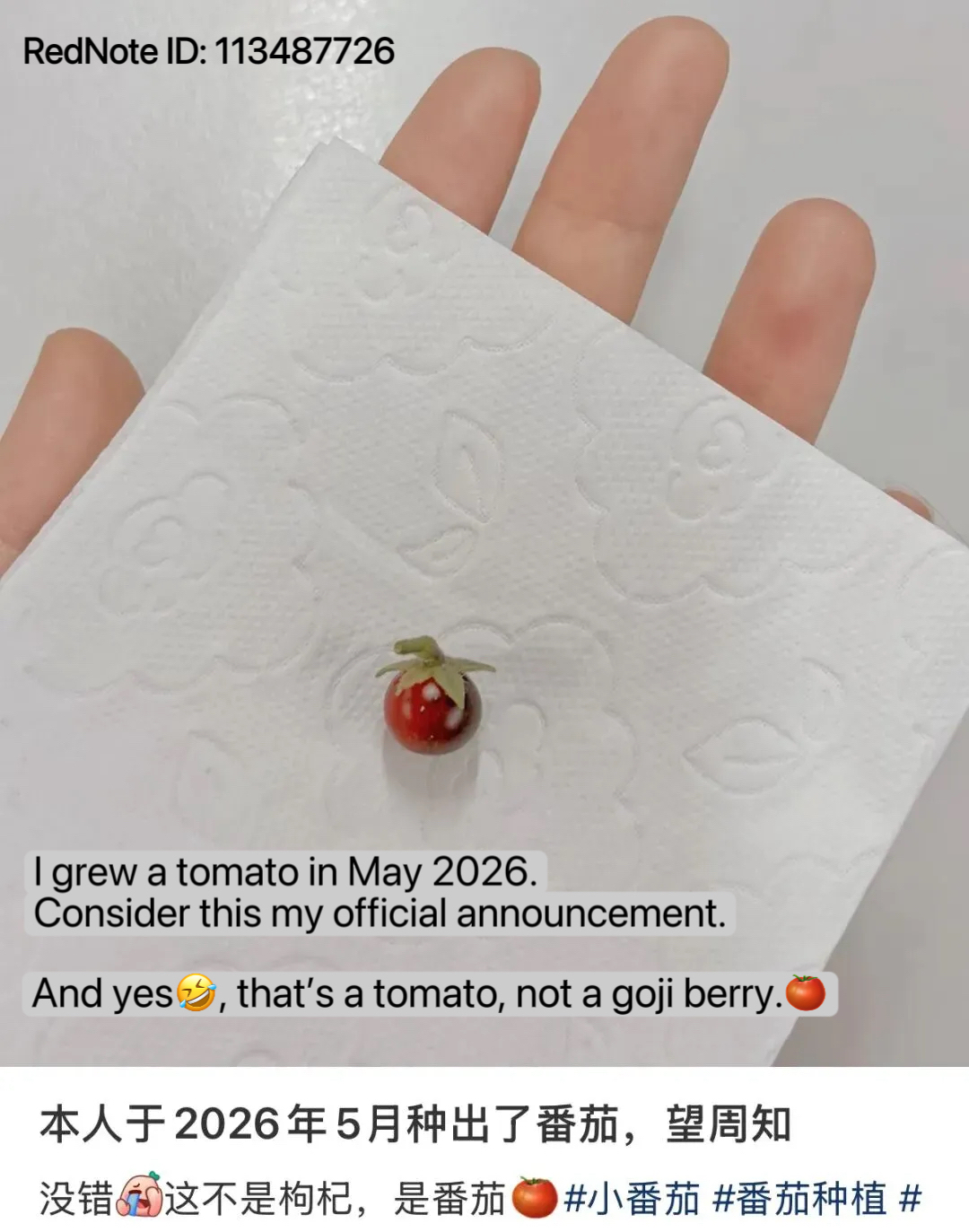
A Chinese netizen's post showing their homegrown tomato (text translated by China.org.cn). [Photo/RedNote APP]
In China, it seems even concrete can become fertile ground.
Why?
In order to understand why so many Chinese people are drawn to growing things, it may be necessary to look beyond the balcony and back in time.
For much of its history, China was an agricultural society. Farming was not simply an economic activity — it shaped the rhythms of daily life, the organization of families, and even the way people understood time.
The traditional Chinese calendar divides the year into 24 solar terms, marking subtle changes in temperature, rainfall and seasonal cycles. For generations, people learned when to sow, when to harvest and when to prepare for the next season. The passage of time was measured not only by dates, but by the growth of crops, the arrival of rain and the flowering of plants.
Many of these habits have outlived the fields that gave rise to them. Even in modern cities, seasonal eating remains deeply embedded in everyday life. People still look forward to spring bamboo shoots, summer melons, autumn crabs and winter vegetables. Freshness is valued not merely as a matter of taste, but as a reflection of being in tune with the season.
Perhaps this helps explain why growing a tomato on a balcony can feel surprisingly meaningful. For many Chinese people, planting something is not only about producing food. It is a way of participating in a cycle that generations before them would have instantly recognized — observing the weather, waiting patiently for growth and finding satisfaction in the gradual unfolding of nature.
Yet practical traditions alone may not fully explain the enduring appeal of growing things. In Chinese culture, the countryside has long occupied a special place in the imagination. More than 1,600 years ago, Chinese poet Tao Yuanming (c. 365-427) famously wrote of picking chrysanthemums under his fence and gazing serenely at distant mountains. His works helped establish an enduring ideal: the countryside as a refuge from worldly pressures and a place of harmony between people and nature.
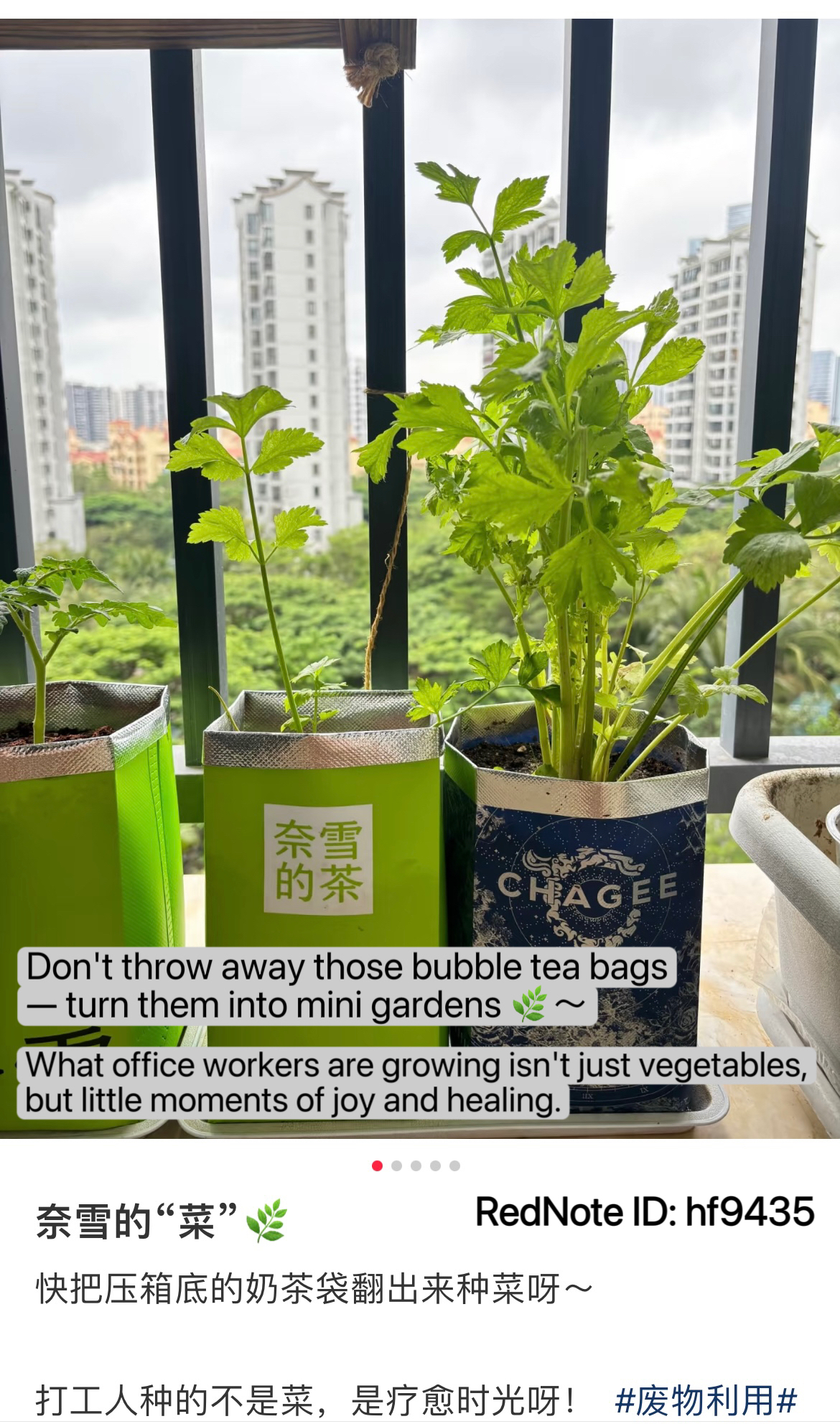
A Chinese netizen's post showing vegetables planted in milk tea takeaway bags (text translated by China.org.cn). [Photo/RedNote APP]
That ideal continues to resonate today. One sign of this is the growing popularity of rural tourism in China, as city dwellers increasingly seek slower-paced experiences in villages and natural landscapes. According to China's Ministry of Culture and Tourism, rural destinations received 793 million visits in the first quarter of 2026, while rural tourism revenue reached 457 billion yuan (around $63 billion).
Videos depicting rural life, gardening and traditional food preparation have also attracted millions of views on social media. One of the best-known figures in the field is Chinese content creator Li Ziqi, whose videos have introduced global audiences to scenes of farming, cooking and seasonal living in China's countryside.
The little tomatoes growing on urban balconies, in this regard, represent something more. They embody a cultural memory shaped by centuries of agricultural life, and a pastoral ideal that continues to find expression in modern urban life.
This connection to cultivation has also traveled across borders. In America, vegetable seedlings raised by an elderly couple from east China's Shandong province became popular among local customers. While in Africa, Chinese peacekeepers stationed there cultivated patches of vegetables beside their camps.
From balconies in Chinese cities to gardens abroad, the settings might change, but the desire to grow something appears remarkably evergreen. It is a quiet habit, shaped by history and sustained by culture, that continues to take root wherever they go.
Perhaps that is why a tomato barely larger than a berry could inspire so much pride.


 京公网安备
11010802027341号
京公网安备
11010802027341号