 Share:

As U.S. President Donald Trump concluded his visit to China in May, international attention once again turned to the future direction of relations between China and the United States. But far from the negotiation tables, another quieter form of diplomacy has continued to unfold — one built not by governments alone, but by ordinary people, and especially young people.
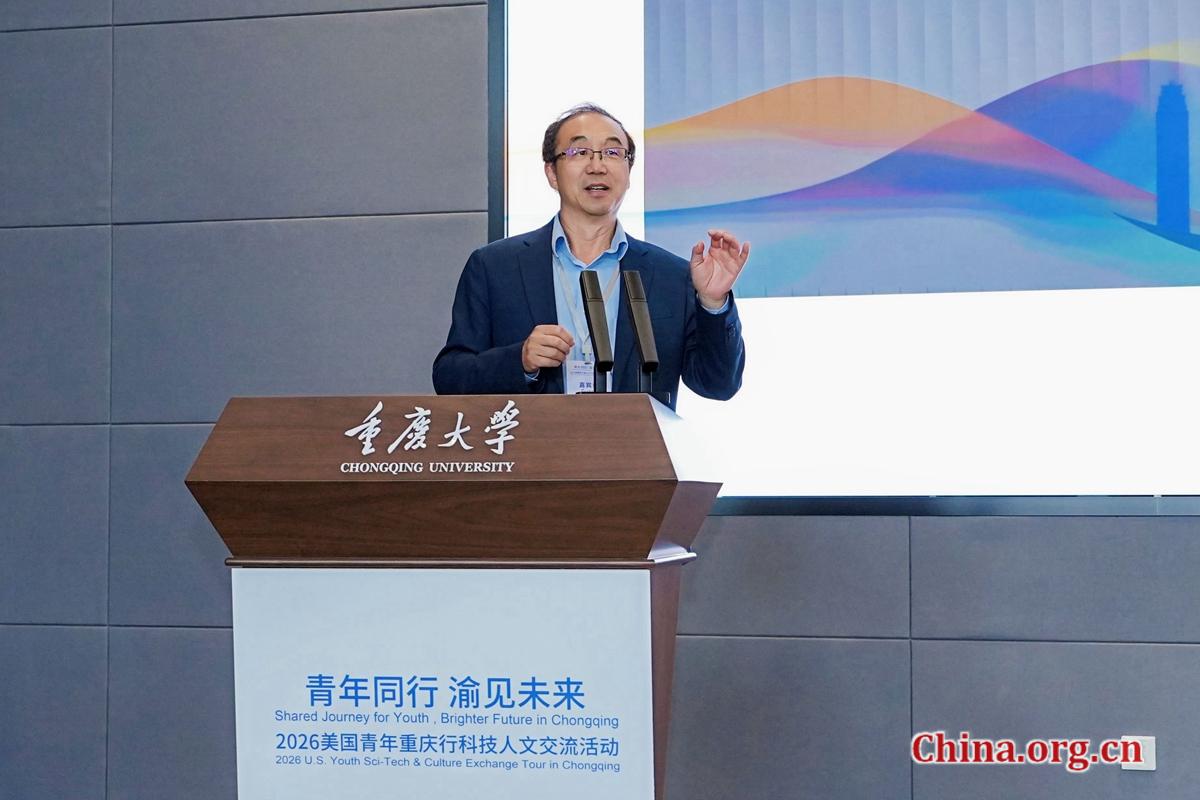
Charlie Xu delivers a speech at Chongqing University during the 2026 U.S. Youth Sci-tech and Culture Exchange Tour in Chongqing in April 2026. [Photo provided to China.org.cn]
For Charlie Xu, president of the American Flying Tigers Friendship Association, that people-to-people connection is what the future of China-U.S. relations relies on.
"Civilian exchanges are the lubricant of diplomacy," Xu said in a recent interview with China.org.cn.
It is a phrase he returns to often. And after years spent organizing American youth delegations to China, Xu believes he has seen firsthand how meaningful exchanges can soften misunderstandings, challenge stereotypes and revive a spirit of friendship that dates back more than eight decades.
Carrying forward the Flying Tigers spirit
This year marks the 85th anniversary of the founding of the Flying Tigers — the wartime cooperation between China and the United States during World War II.
In 1941, General Claire Lee Chennault led the American Volunteer Group, later famously known as the Flying Tigers, to assist China in resisting Japanese aggression. Flying dangerous missions over China and the Himalayas, the young American pilots became symbols of courage and solidarity. More than 2,000 Flying Tigers members sacrificed their lives in China, while Chinese civilians rescued hundreds of downed American pilots.
For Xu, the meaning of the Flying Tigers legacy can be distilled into two words: friendship and cooperation.
"At that time, Chinese and Americans stood side by side against fascism, and the friendship formed during those difficult years became a lasting bond between our peoples," he said. "Its relevance today lies in reminding us that even amid complexities and challenges, people can still choose understanding, trust and cooperation."
Xu's personal connection to that history runs deep. He is the nephew of Anna Chennault, widely known in China as Chen Xiangmei, who devoted decades to promoting China-U.S. friendship after the war.
In 2015, Xu accompanied her to China during commemorations marking the 70th anniversary of victory in the Chinese People's War of Resistance Against Japanese Aggression. What struck him most was not ceremony, but memory.
"The warmth Chinese people still showed toward the Flying Tigers deeply moved me," Xu recalled.
After returning to the U.S., he helped establish the American Flying Tigers Friendship Association, hoping to preserve the spirit of wartime solidarity for younger generations.
Today, however, Xu sees the Flying Tigers not simply as a historical memory, but as a bridge for continued people-to-people exchanges between China and the U.S.
Bringing American youth to China
Rather than relying solely on forums, exhibitions or commemorative ceremonies, Xu chose a more direct approach in recent years: bringing young Americans to China to experience the country for themselves.
Under initiatives encouraging greater China-U.S. youth exchanges, the association has organized multiple youth delegations to cities including Beijing, Chongqing, Chengdu, Zhuhai, Macao and Chengde over the past year.
The participants are often students from leading American universities, including the University of California, Berkeley, the University of California, Los Angeles and the University of Southern California.
The momentum is expected to continue later this year, with additional exchange visits planned for several Chinese cities, including Guangzhou, where an American youth delegation is scheduled to arrive later this month.
Xu believes these young visitors matter not only because they are students today, but because many may become scientists, entrepreneurs, engineers or policymakers tomorrow.
"The quality of the next generation of China-U.S. relations depends on whether young people understand each other," he said.
The exchange programs focus heavily on science, technology, innovation and cultural immersion. Delegates visit universities, laboratories, advanced manufacturing facilities and technology companies. They also experience traditional Chinese culture through activities such as calligraphy, paper-cutting, traditional medicine workshops and local community exchanges.
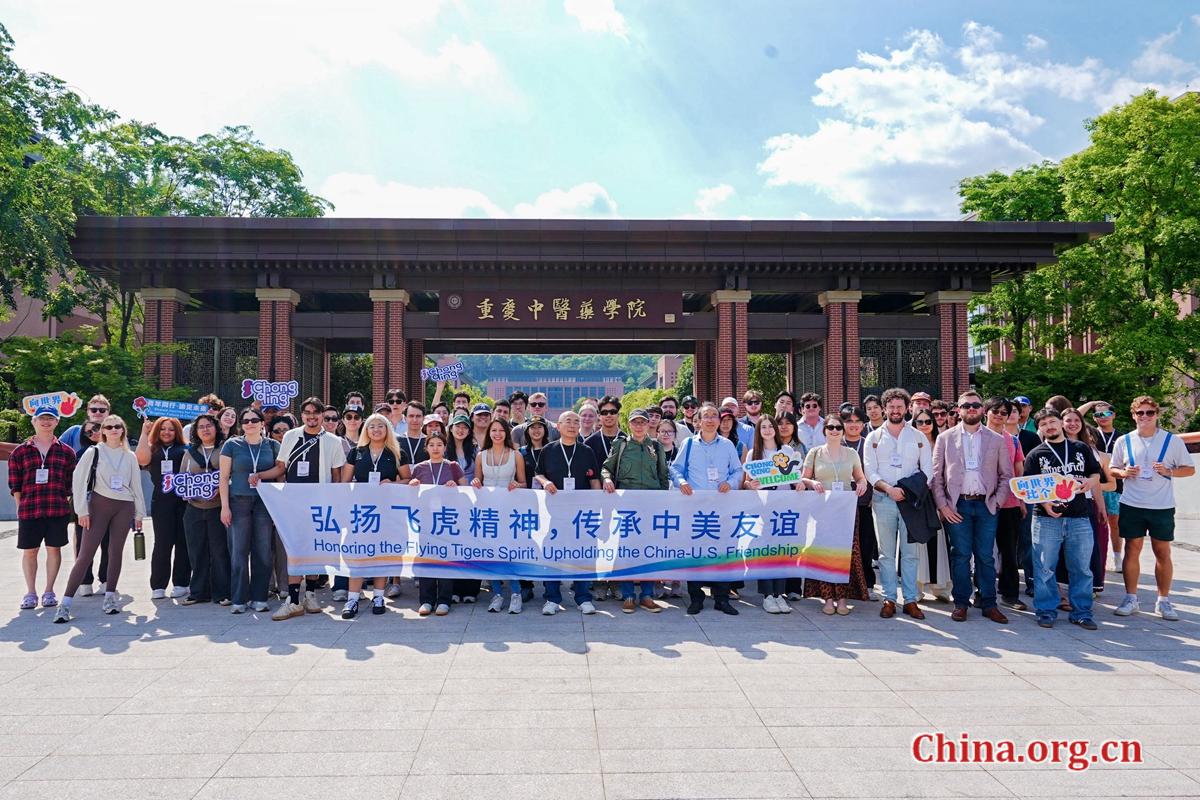
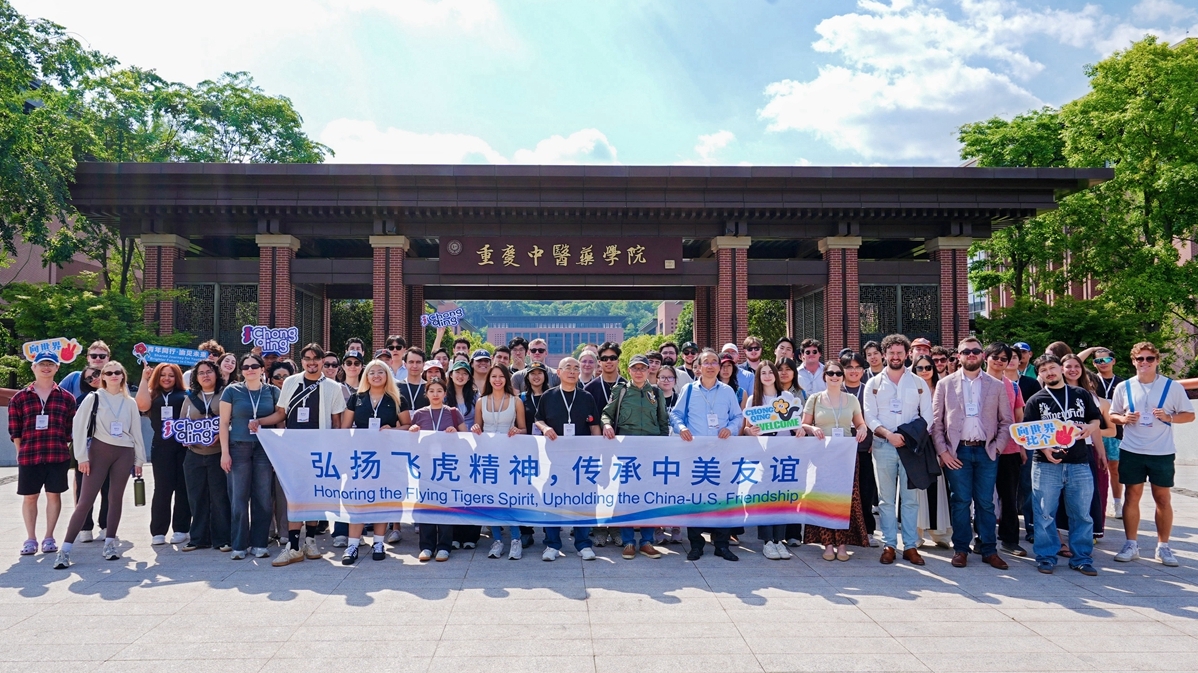
Participants in the U.S. Youth Sci-tech and Culture Exchange Tour visit Chongqing University of Chinese Medicine in Chongqing in April 2026. [Photo provided to China.org.cn]
In Chongqing earlier this year, more than 100 American students and scholars participated in a four-day science and cultural exchange program. They visited Chongqing University, learned more about traditional Chinese medicine and toured local tech enterprises.
For many participants, it was their first visit to China and their first direct encounter with the country beyond media portrayals. Many knew little about the Flying Tigers before joining the program, Xu said.
Xu recalled the reactions of American students watching a massive 5,000-drone nighttime light show in Chongqing. Others were struck by China's high-speed transportation systems, urban infrastructure, digital payment systems and delivery services.
"Many students tried using apps like Meituan for the first time and were amazed at how convenient everything was," he said with a laugh. "One student joked that he hadn't touched cash for days after arriving in China."
Beyond technology, many students were just as impressed by the country's cultural heritage. Visiting the Great Wall was often one of the most memorable moments of the trip for the youngsters.
"When they finally stood on the Great Wall, many became unusually quiet," Xu said. "They were no longer seeing China from textbooks or videos. They were experiencing thousands of years of history firsthand."
But Xu stressed that the trips are about more than introducing young Americans to China's technological achievements and cultural heritage.
"The deeper value lies in dialogue," he said. "When American students talk directly with Chinese students, scientists and ordinary people, they discover that people on both sides are actually very friendly toward one another."
Youth as ambassadors
Xu often describes the young participants as "civilian ambassadors."
He encourages them not only to visit China, but also to share their experiences after returning home — through conversations, classrooms and social media platforms such as Facebook, Instagram and X.
"When they tell their own stories, it carries more credibility," Xu said. "People trust what their friends personally experienced."
He believes such grassroots storytelling can help counter misinformation and reduce mutual suspicion at a time when bilateral relations have faced challenges.
At times, uncertainties in China-U.S. relations made it difficult to recruit participants for exchange programs, Xu recalled. Some American parents worried about political tensions and were hesitant about letting their children travel to China. However, Xu believes recent high-level interactions between China and the U.S. may provide a timely opportunity to rebuild confidence.
"When government leaders engage and relations stabilize, parents feel more reassured," he said. "That creates better conditions for more civilian exchanges."
Xu believes that high-level diplomacy and people-to-people exchanges should not be seen as separate tracks, but as mutually reinforcing forces. In his view, the enduring relevance of the Flying Tigers lies precisely in their ability to connect people across generations and national boundaries.
"The Flying Tigers spirit belongs not only to history, but also to the future," Xu said.
For him, the legacy of the Flying Tigers is no longer confined to wartime heroism. It lives on whenever young Chinese and Americans meet with openness, respect and a willingness to learn from one another. He believes the spirit first forged in wartime skies over China can continue to serve as a bridge across the Pacific through dialogue, exchanges and youth engagement.


 京公网安备
11010802027341号
京公网安备
11010802027341号