 Share:

A cultural dialogue centered on "Cross-Disciplinary Integration in Chinese and Russian Cultural Arts" was held in St. Petersburg on April 30 alongside performances of "Swan," a major acrobatic production by the Guangzhou Acrobatic Troupe, at the Mariinsky Theatre.
Setting aside broad generalities, the gathering focused on the integrated development of stage design, bringing together performing artists, leading designers and cultural industry figures from both countries for a substantive exchange spanning stage practice and industry implementation.
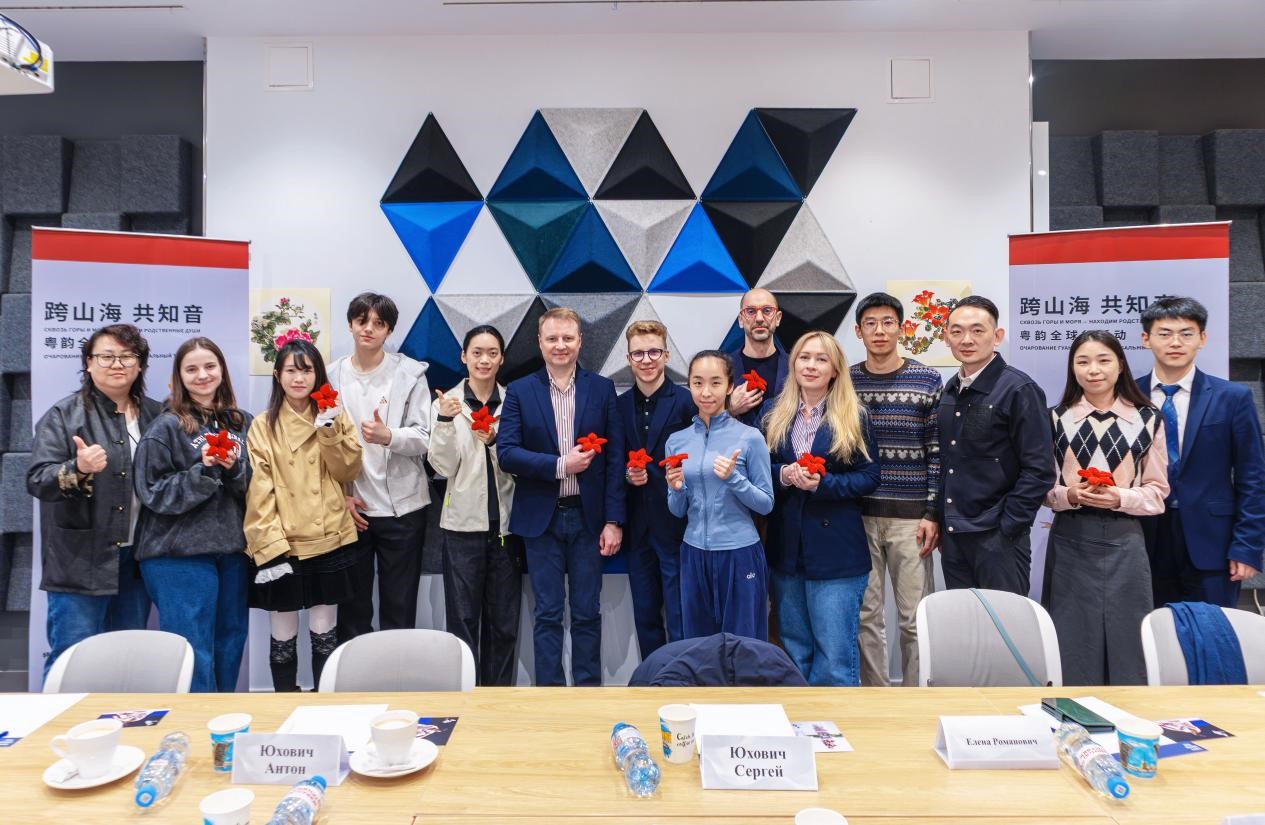
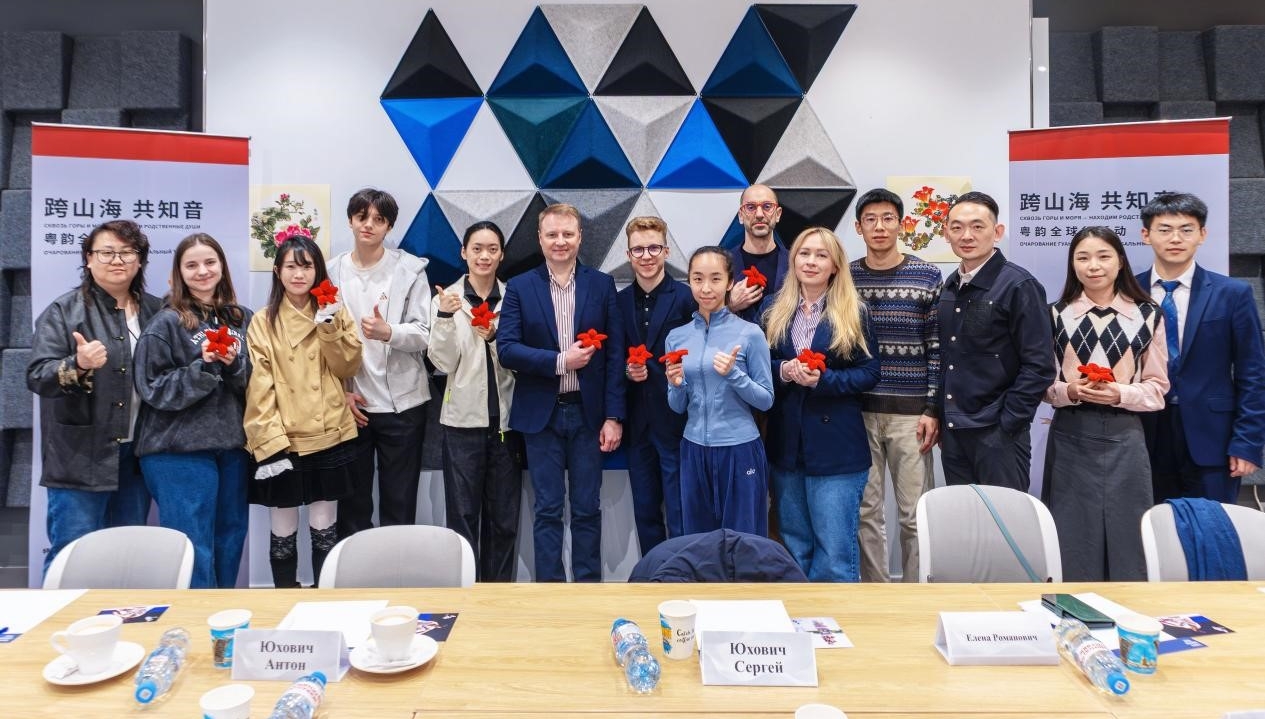
Participants pose for a photo during a China-Russia stage design dialogue held in St. Petersburg, Russia, April 30, 2026. [Photo provided to China.org.cn]
Two young lead performers, Ma Chenlu and Su Shanshan, brought a firsthand on-stage perspective to the discussion. Drawing on their own work in "Swan," they described how the troupe's signature form — shoulder ballet — has become a vehicle for fusing Chinese and Russian artistic sensibilities.
Ma described how, in executing the production's most demanding lifts, she infuses the breath control and emotional cadence of ballet into the precise architecture of acrobatics, transforming sheer danger into something poetic.
Su offered a closer look at the physical vocabulary of her character, explaining how it draws on the essence of Russian ballet while incorporating the suppleness and strength distinctive to Chinese acrobatics, yielding a stage presence that carries an Eastern spirit while resonating with international audiences.
Their accounts demonstrated that genuine fusion begins in the performer's body, with cultural dialogue taking shape in every breath and extension.
Representing a prominent Russian design studio, Gabriele Valentinuzzi and Elena Romanovich steered the conversation toward the visual aesthetics of the production. Speaking from a designer's perspective, they praised the narrative coherence "Swan" achieves through its costumes, lighting and spatial choreography.
Both sides explored how visual elements — color, material, line — can be deployed across distinct Chinese and Russian cultural contexts to express each nation's aesthetic character while opening up a shared emotional space.
The Russian designers noted that the success of "Swan" lies in a visual design that goes well beyond a simple collage of cultural symbols: it engages with the heart of the script and builds a coherent aesthetic system, offering a valuable model for future China-Russia co-productions.
The dialogue also turned to the industrial infrastructure underpinning artistic creation. Sergey Yukhovich, general manager of Russia's Mashservis, and company representative Anton Yukhovich shared insights on cultural-equipment technology and project operations management.
They observed that a production like "Swan," which combines demanding acrobatics with precision ballet, places extraordinary demands on stage machinery, safety systems and project management. The Russian side expressed strong interest in deeper cooperation with Chinese counterparts on professional performance equipment, technical solutions and international tour operations, saying that robust industrial collaboration is the foundation on which outstanding works can be sustainably produced and brought to wider audiences.
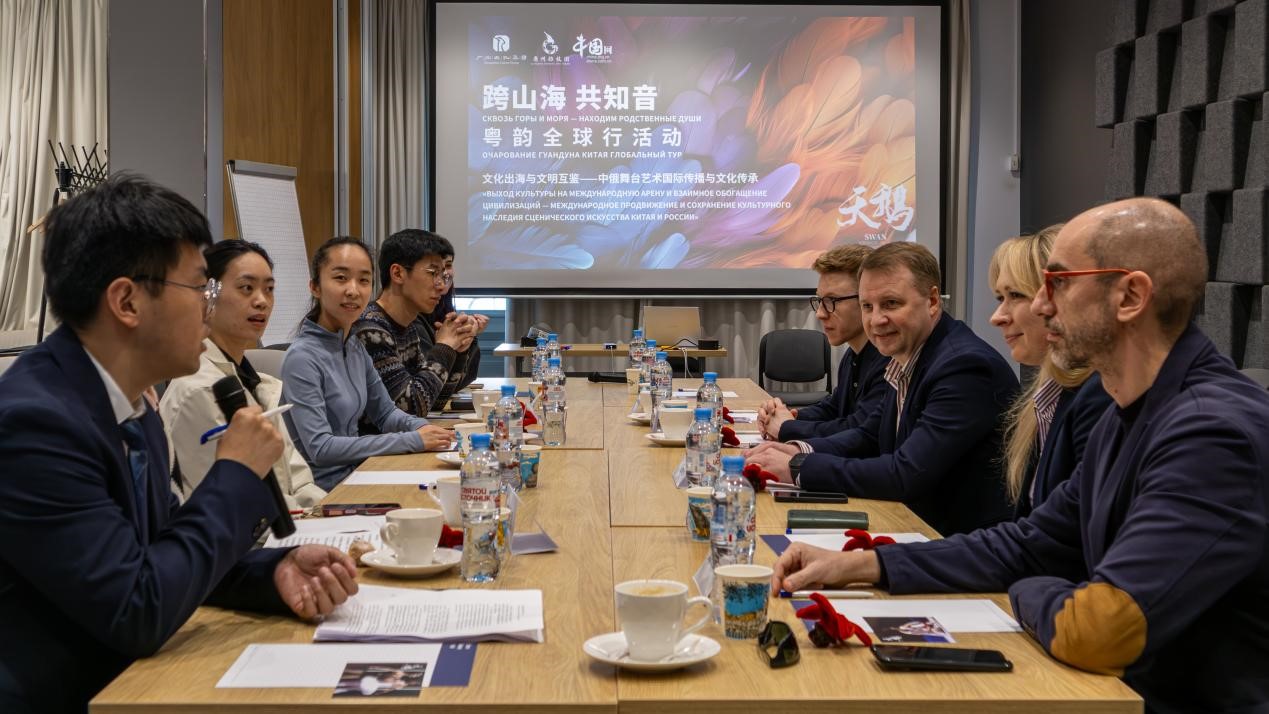
Chinese and Russian participants exchange views during a China-Russia stage design dialogue held in St. Petersburg, Russia, April 30, 2026. [Photo provided to China.org.cn]
Although the dialogue took a single production as its starting point, the conversation reached well beyond the production itself. It established a tripartite "performance-design-industry" model of exchange, reflecting a broader shift in international cultural cooperation: away from straightforward touring engagements and toward full-value-chain partnerships spanning creative design, technical standards and market development.
As a cultural envoy connecting China and Russia, the Guangzhou Acrobatic Troupe's "Swan" fostered a deep exchange between professionals on both sides and built a practical platform for future cooperation.
The success of this dialogue underscores the active role Guangzhou plays — as a national central city and international communications hub — in advancing cultural exchange between China and the wider world, and signals that China-Russia cultural engagement is moving toward a more professional, systematic and sustainable phase of development.
Guangzhou will continue to draw on its geographic position and cultural heritage to promote international cultural exchange, laying the groundwork for China and Russia to deepen cooperation in the arts and humanities.


 京公网安备
11010802027341号
京公网安备
11010802027341号