 Share:

As China's first National Reading Week concluded on Sunday, several leading science fiction writers urged the public to embrace deep, immersive reading as an antidote to the fragmentation of the digital age.
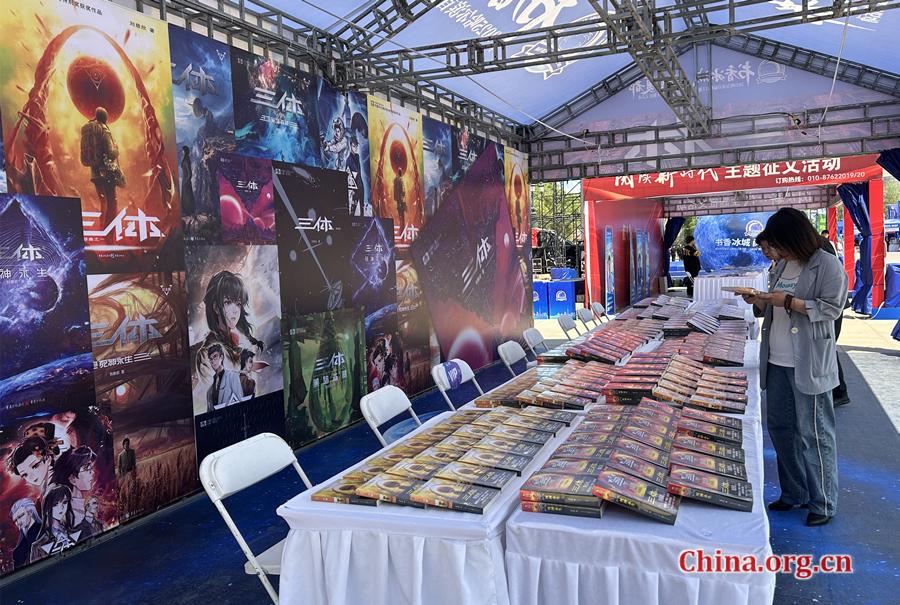
A booth for "The Three-Body Problem" at a sci-fi book fair in Harbin, Heilongjiang province, May 23, 2025. [Photo/China.org.cn]
The week-long initiative, which began on April 20 and also marked World Book and Copyright Day on April 23, sparked reflections from some of the country's most prominent voices in speculative fiction about the enduring value of reading in an era of artificial intelligence, short videos and algorithmic content.
Wu Yan, a professor at the Southern University of Science and Technology and science fiction writer, said reading has become particularly important in an age where AI, digital visual technology and overloaded online information have fragmented the way people think and collect information.
"In such a fragmented era, people still need a broad framework to integrate these pieces," Wu said. "Complete reading can achieve that."
Wu noted the overwhelming volume of new publications, with 190,000 sci-fi online novels released last year alone and more than 500 new sci-fi books in print. "So, during reading week, people need to choose carefully. Paying attention to experts' recommendations and reviews is crucial, and we need such experts," he said.
Jiang Bo, another prominent sci-fi author, emphasized that reading remains the most important means for humans to gain knowledge and develop intelligence, especially as AI flourishes and short videos dominate attention spans.
"Emphasizing reading and the way knowledge is acquired has taken on new significance in this era," Jiang said. "For Chinese science fiction, although the genre can gain wide dissemination through film and television, text remains the source of creativity and can accommodate broader imaginative worlds."
He believes that National Reading Week has the potential to reignite public passion for reading, allowing people to revisit classics and discover new works.
Renowned sci-fi writer, editor and sci-fi project promoter Cheng Jingbo described reading as a proactive choice to resist restlessness and rebuild people's ability to think deeply amid the noise of modern life.
"The popularization of reading nationwide means an expansion of the reader base and an elevation of aesthetic thresholds," she said. "When more people become accustomed to deep reading, they can better understand the complex interplay of scientific logic and humanistic reflection in sci-fi works. This in turn will inspire creators to explore more hardcore and more locally rooted narratives."
Cheng added: "Only a nation that loves reading can give birth to science fiction that truly looks up at the stars — because the foundation of science fiction has never been special effects, but imagination rooted in reality."
She expected National Reading Week to be not just a week of ritual observance, but rather an opportunity to promote reading accessibility — a chance for children in remote areas and people in public spaces such as subways, communities and cafes to gain access to quality books through the event.
Yang Feng, founder and CEO of the Chinese sci-fi brand Eight Light Minutes Culture, echoed Cheng, saying reading in the fragmented information age is no longer just a means of acquiring knowledge, but a way to maintain inner strength and independent thinking.
"It allows us to have the power of solitude amid the noise, to open countless parallel worlds beyond reality, and to sustain imagination, empathy and judgment," she said. "This is the most solid foundation of a person's — and a nation's — spiritual character."
She noted that reading is the starting point for the entire industry chain — from discussion and word-of-mouth to film, animation and stage adaptations. She hopes that National Reading Week will not just be a high-profile event but become a sustained habit, bringing reading into daily life, into campuses and into the lives of ordinary people.
Dong Renwei, a prominent figure in sci-fi and popular science, was characteristically blunt: "Reading is a required course for the inheritance of civilization." His recommendation: "Read 'The Three-Body Problem' several times. It's irreplaceable."
Meanwhile, author of "Chongqing on the Dinosaur's Spine" Xiao Xinghan called books the "world's cheapest luxury goods," and compared reading week to a grand feast that places luxury before everyone.
"Books I read in my youth have had an increasingly profound impact on me as I've grown older," Xiao said. "Though there are now many ways to acquire knowledge and information, I still firmly believe that books and reading play an irreplaceable role in personal growth, the cultivation of character and quality, and the formation of one's worldview, values and outlook on life."


 京公网安备
11010802027341号
京公网安备
11010802027341号