 Share:

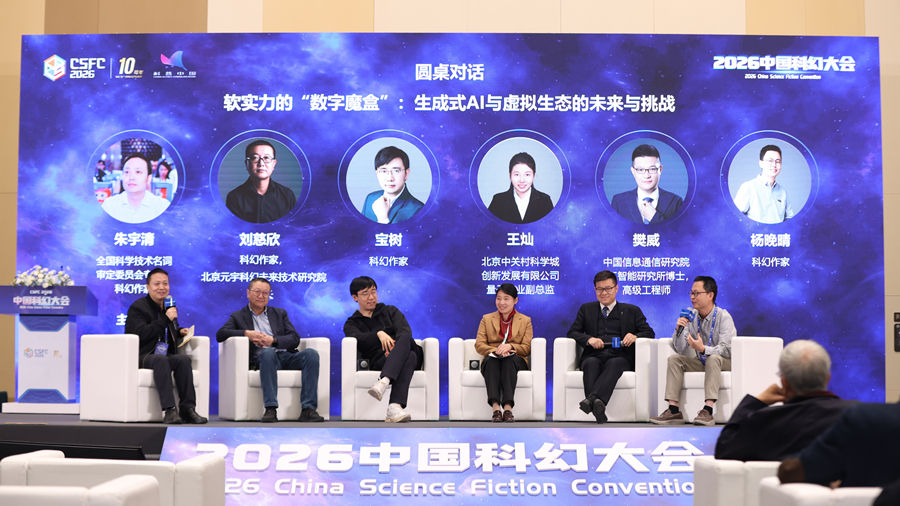
At the 2026 China Science Fiction Convention held in Beijing on March 28, several leading Chinese sci-fi writers and experts gathered to discuss the development of AI and their visions for its future. Among them, sci-fi luminary Liu Cixin said that AI might help humanity break out into the universe for the benefit of humanity.
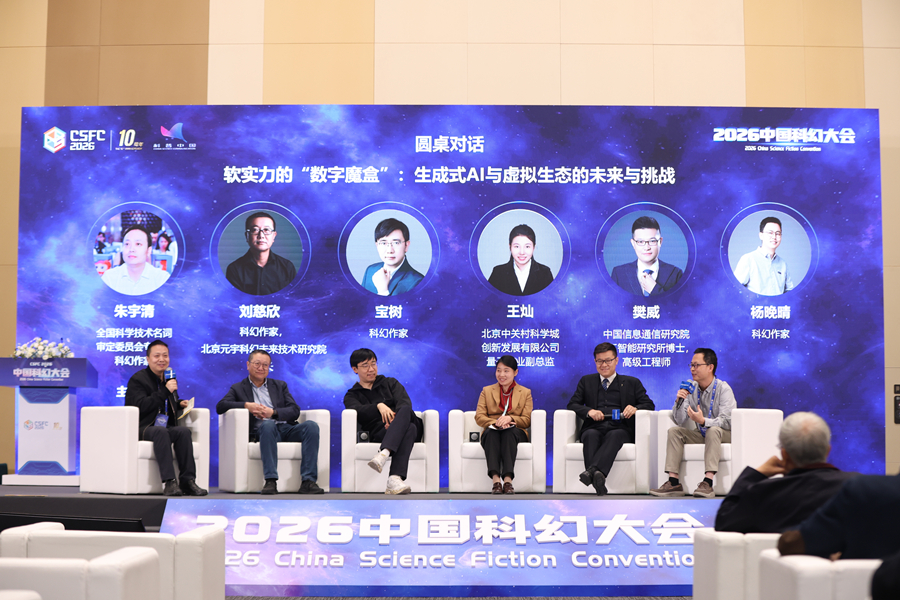
Roundtable participants discuss the future and challenges of generative AI and virtual ecosystems during the 2026 China Science Fiction Convention in Beijing, March 28, 2026. [Photo/China.org.cn]
Liu, who also serves as president of the Beijing Yuanyu Science Fiction and Future Technology Research Institute, shared his thoughts at a roundtable discussion on the future and challenges of generative AI and virtual ecosystems. "AI may be the only key to breaking through humanity's cognitive ceiling," he noted.
Liu put forward a grand vision: "The ultimate ideal of human civilization — to spread across the universe — may not be achieved by biological humans, but by the AI successors we create. The process of humanity being replaced by AI may be happening peacefully, as a gradual and imperceptible shift. What the future will look like is something we can hardly predict."
In the face of the explosion of generative AI, sci-fi writer Yang Wanqing believes that AI, as a tool for output, can help liberate humanity from heavy physical labor. Just as the invention of writing made knowledge accessible, the development of AI is an inevitable trend in the progress of civilization.
Regarding AI safety, Fan Wei, a senior engineer at the Artificial Intelligence Research Institute of the China Academy of Information and Communications Technology, pointed out the "brake failure" problem facing current AI development.
He explained that 99% of resources at major tech companies are currently invested in development, with only 1% allocated to safety. "The rapid iteration of large model technology results in a natural lag in safety technology," he warned, calling for technological early warning systems and stressing the need to establish red lines through institutional frameworks and strengthen the bottom line through laws — which he described as "humanity's last line of defense."
A second roundtable forum focused on the "physical boundaries" of hard technology and risk management when robots and aircraft enter the real world. Sci-fi writer Yang Ping stepped away from the dramatic narratives often found in traditional science fiction — such as robots taking over and enslaving humanity — and instead focused on the real-world ethical dilemmas that arise after technology is deployed.
"In a future society where humans and machines coexist, the real risk may not come from robots developing rebellious consciousness, but from the 'unconscious' data security issues that emerge in everyday use," he said.
Writer Su Xuejun raised questions from the perspectives of war and geopolitics. Drawing on the actual use of drones and unmanned equipment in real-world conflicts, he pointed out that warfare is moving toward an increasingly unmanned reality. He warned that technological development is a double-edged sword. If technology fails to generate sufficient incremental wealth, human society may face a major crisis — one that could even steer AI technology toward malicious purposes.
Another sci-fi luminary, Wang Jinkang, also turned his attention to the more serious domain of military affairs, expressing deep concern over the potential loss of control of AI in highly adversarial military environments. He specifically mentioned swarm drone technology, warning that if humanity loses control over the AI kill chain in high-intensity military logic, the consequences could be catastrophic.
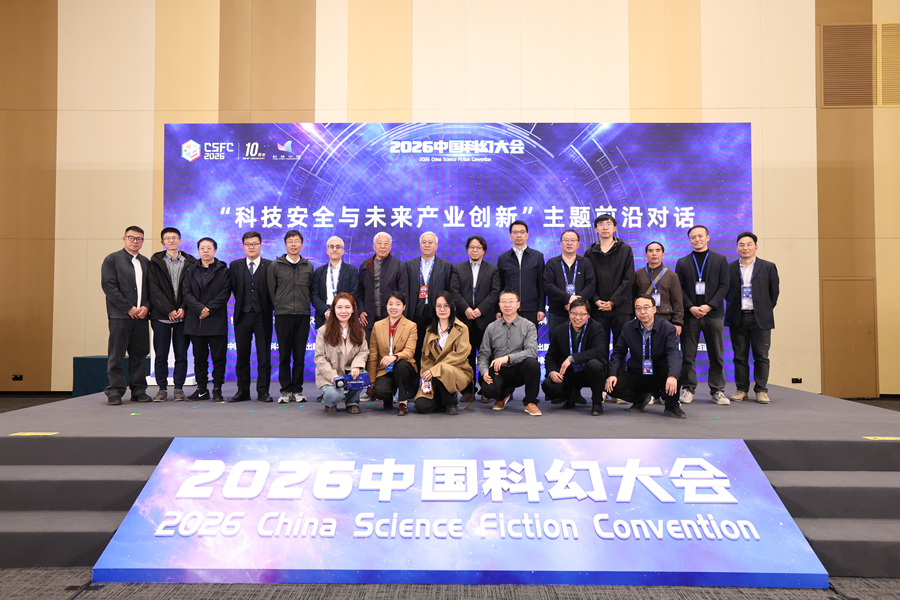
Forum participants pose for a group photo at the 2026 China Science Fiction Convention in Beijing, March 28, 2026. [Photo/China.org.cn]
The roundtable panels were part of a cutting-edge dialogue forum themed "Technology Security and Future Industry Innovation." As the new round of technological revolution and industrial transformation accelerates, emerging technologies are reshaping the ways people live and work while also presenting unprecedented security challenges and ethical issues. This forum aimed to break down industry barriers and build a high-level cross-sector dialogue platform, transforming the "thought experiments" of science fiction into "early warning systems" for technology governance, providing forward-looking insights for future industrial innovation.


 京公网安备
11010802027341号
京公网安备
11010802027341号