Share:

A forum held in Beijing on Friday brought together sci-fi writers, scientists and publishers to break down industry barriers and forge new connections between science fiction and science communication.
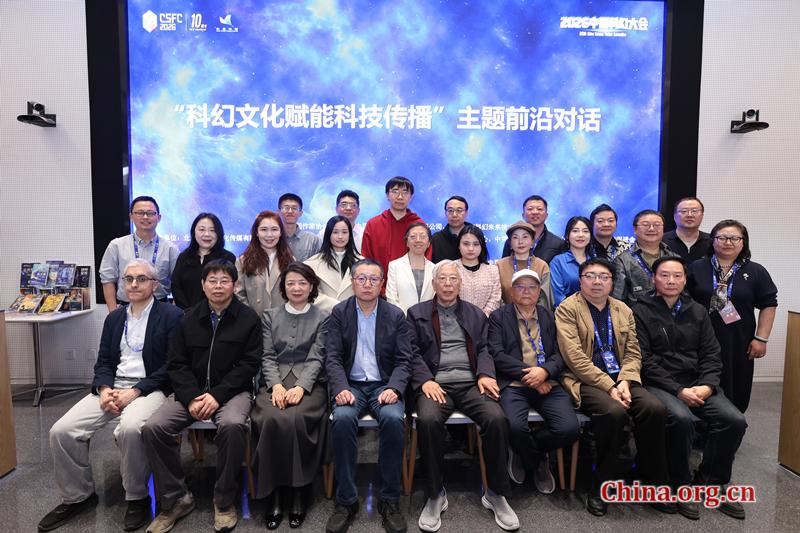
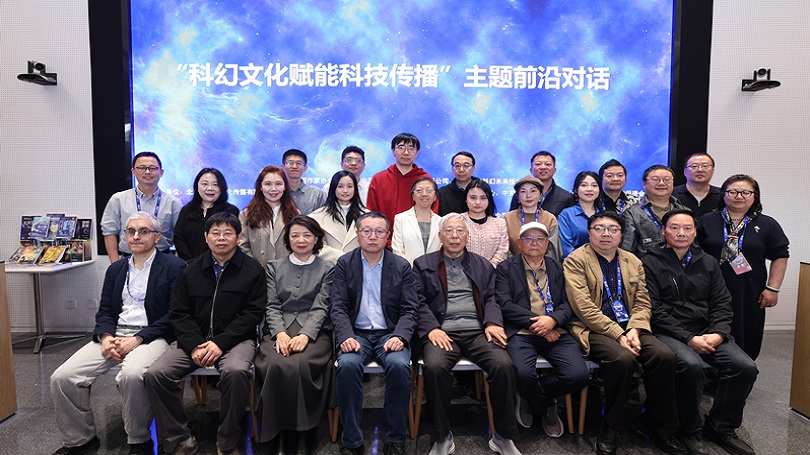
Participants pose for a photo at a sci-fi forum in Beijing, March 27, 2026. [Photo/China.org.cn]
The event, organized by the Social Union Department of the China Writers Association, China Science and Technology Press and the Beijing Yuanyu Science Fiction and Future Technology Research Institute, explored new models for integrating science fiction and technology under the theme "Science Fiction Culture Empowering Science Communication."
"Science fiction is the crystallization of science and imagination — a unique vehicle for making complex scientific and technological knowledge accessible," said Xu Shixin, deputy editor-in-chief of China Science and Technology Press.
He pledged that the publishing house will continue to explore new publishing models combining science fiction and technology, foster dialogue between writers and scientists, and deepen the integration of sci-fi culture and science communication.
Bao Honglie, director of the Social Union Department of the China Writers Association, pointed out that Chinese sci-fi literature is an expression of China's drive to build strength in science and technology, serving as an important bridge between science and the humanities while inspiring the nation's innovative vitality.
"The China Writers Association will continue to promote the development of sci-fi literature, break down industry barriers, build a new cross-disciplinary ecosystem integrating literature, technology and communication, and cultivate sci-fi brands that are distinctly Chinese with global influence," he said.
At the forum, Bao released the 2025 China Science Fiction Literature Development Report, presenting a comprehensive overview of the sector's annual development. The report showed that China's science fiction publishing industry achieved total revenue of 5.41 billion yuan ($740 million) in 2025, a year-on-year increase of 54.1%, marking eight consecutive years of growth. A total of 727 sci-fi books were published throughout the year, with 242 works exported overseas in more than 10 languages.
The report identified several key trends, including the continued expansion of industrial scale, the rise of writers born in the 1980s and after as the creative backbone of the sector, and 35.6% growth in children's sci-fi. Online and published sci-fi were identified as the two pillars of the ecosystem.
Creative themes have also turned inward, the report noted, with emotional narratives, AI ethics and mythological reinterpretation emerging as dominant areas of interest.
The sector also faces challenges, including thematic homogenization, balancing technology and literature, and the ethics of AI-assisted creation. Even so, Chinese sci-fi is transitioning from scale expansion to high-quality development focused on structural optimization and deeper substance.
Sci-fi writer Li Yiqian shared his thoughts on the intersection of sci-fi and real-world technology. He argued that AI is a tool to serve humanity, and that the core of science fiction lies in protecting human curiosity and imagination.
Sci-fi creation should focus on exploring the unknown and pushing boundaries with imagination, he said, conveying a spirit of enterprise and progress.
During the forum, China Science and Technology Press unveiled its annual science fiction highlights, including four major sci-fi book series.
In a separate ceremony, Liu Cixin, Wang Jinkang, Xu Shixin and Wang Weiying, director-general of the Beijing Yuanyu Science Fiction and Future Technology Research Institute, jointly launched the Science Fiction China Creative Research Center and established studios for five sci-fi writers: He Xi, Ling Chen, Su Xuejun, Baoshu and Peng Liurong.
Two roundtable panels followed, bringing together sci-fi writers and experts. One explored whether sci-fi serves as a "sandbox for technological development," with participants arguing that it acts as a conceptual testing ground where the possibilities of technological advancement can be safely simulated, offering forward-looking warnings and inspiring creative ideas.
The other panel focused on telling compelling Chinese science and technology stories through Eastern sci-fi aesthetics. Participants proposed that Eastern sci-fi should be grounded in a universal scientific framework while incorporating cultural values such as harmony, coexistence and a sense of home.
Rather than relying on superficial symbolism, they said, the goal should be creating works that reflect Chinese character while appealing to a global audience.
The China Science Fiction Convention 2026 took place in Beijing from March 27 to 29.
China's science fiction industry generated total revenue of 126.1 billion yuan in 2025, according to a report released by the China Research Institute for Science Popularization at the convention's opening on Friday, marking three consecutive years above the 100 billion yuan threshold.


 京公网安备
11010802027341号
京公网安备
11010802027341号