 Share:

The jury for the sci-fi literature category of the Science Fiction Planet Competition finals convened Monday in Beijing to determine the final shortlists and winners for the fourth Science Fiction Planet Awards at the end of March.
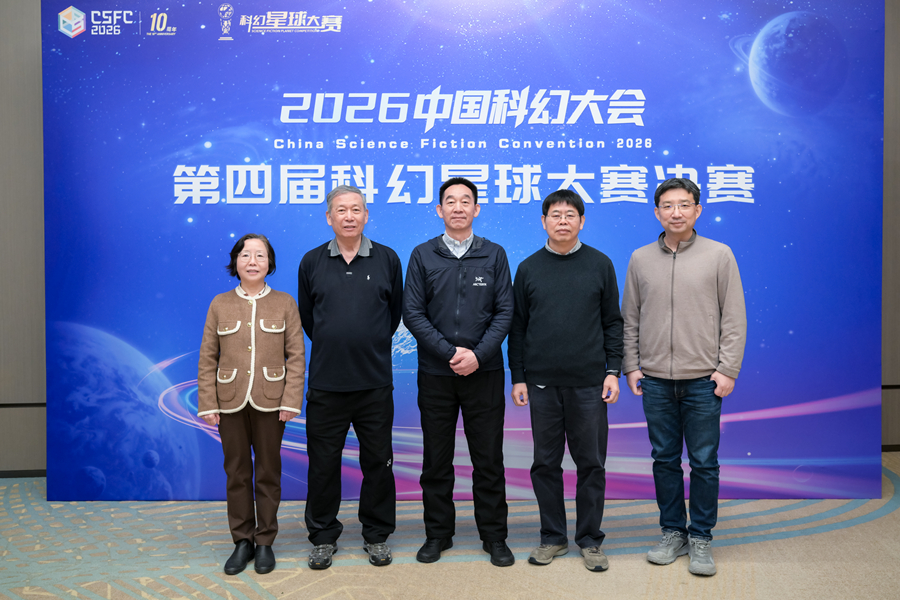
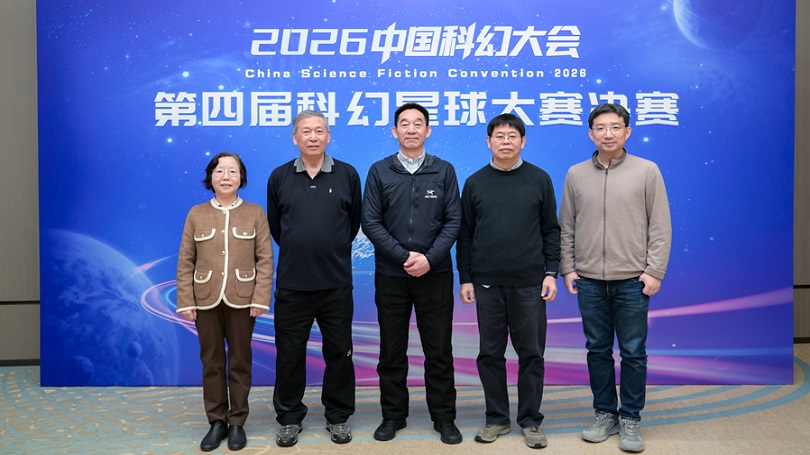
Jurors for the Science Fiction Planet Awards pose for a photo at a meeting to deliberate the winners in Beijing, March 16, 2026. [Photo courtesy of Beijing Yuanyu Science Fiction and Future Technology Research Institute]
This year's jury featured a distinguished lineup, comprising seven high-level experts, including Shi Zhanjun, member of the China Writers Association Presidium; renowned sci-fi author Liu Cixin; and Agustin Alepuz Morales, a prominent Spanish sinologist and translator.
Upholding the principles of professionalism, rigor and fairness, the jury determined the nine winning works in the literary competition category. They also selected four projects for the Science Fiction Rising Star Support Program (literary direction), thereby promoting high-quality original content and emerging talent for the future of Chinese sci-fi literature.
This year's competition introduced an innovative evaluation mechanism for its literary category, departing from previous judging models. Advancing projects went through rounds including pitch presentations, expert questioning and live defense sessions, with teams comprehensively presenting their works' core concepts, creative approaches and future development potential.
The Science Fiction Planet Competition's sci-fi literary category working group received a total of 330 submissions. After the selection process, 271 works met the eligibility criteria, with 95 advancing to the preliminary round. Following online evaluation in the semifinals, the top 10 in each sub-category entered the online pitch review stage. Following this review process, five sci-fi novels, five novellas and short stories, and six sci-fi works for young readers progressed to the finals. Additionally, six works entered the finals for the Science Fiction Rising Star Support Program (literary direction).
Works such as Yang Wanqing's Galaxy Award- and Chinese Nebula Award-winning "Golden Peaches," Xiao Xinghan's new book "Chongqing on the Dinosaur's Spine" and sci-fi luminary Wang Jinkang's "Xing Ge San Die" made the top-five shortlist for sci-fi novels, with Cheng Jingbo's "Let the White Deer Roam" and Zhang Ran's "Still Water" appearing in the shortlist for novellas and short stories. Meanwhile, sci-fi children's and teen books such as Dong Renwei's "Molecular Archaeology Team" and Ma Chuansi's "The Melodies of Fishing by Leichi Lake" have been shortlisted in the sci-fi works for young readers sub-category.
The winners, selected by the jury panel, will be revealed on March 29 at a gala award ceremony to be held during the 10th China Science Fiction Convention.
The fourth Science Fiction Planet Awards is a flagship event of the China Science Fiction Convention and will be held from March 27-29. It features a total prize pool of 6.65 million yuan ($966,000) and has categories for technologies, literary works, IPs and rising talent. The sci-fi literature category has a total prize pool of 1.7 million yuan.
The Science Fiction Planet Awards was founded in 2021 by sci-fi writers Wang Jinkang, Liu Cixin and Wu Yan, along with movie director Frant Gwo. Organizers describe the event as the first international sci-fi competition of its kind based in China, which aims to use sci-fi culture to connect the entire chain from creative incubation to industrial transformation, promoting greater integration of sci-fi with technology, culture and related industries.


 京公网安备
11010802027341号
京公网安备
11010802027341号