 Share:

A seminar commemorating science fiction author Su Xuejun's 30-year career was held in Beijing on Feb. 5, gathering fellow sci-fi writers, scholars and industry representatives to celebrate his work.
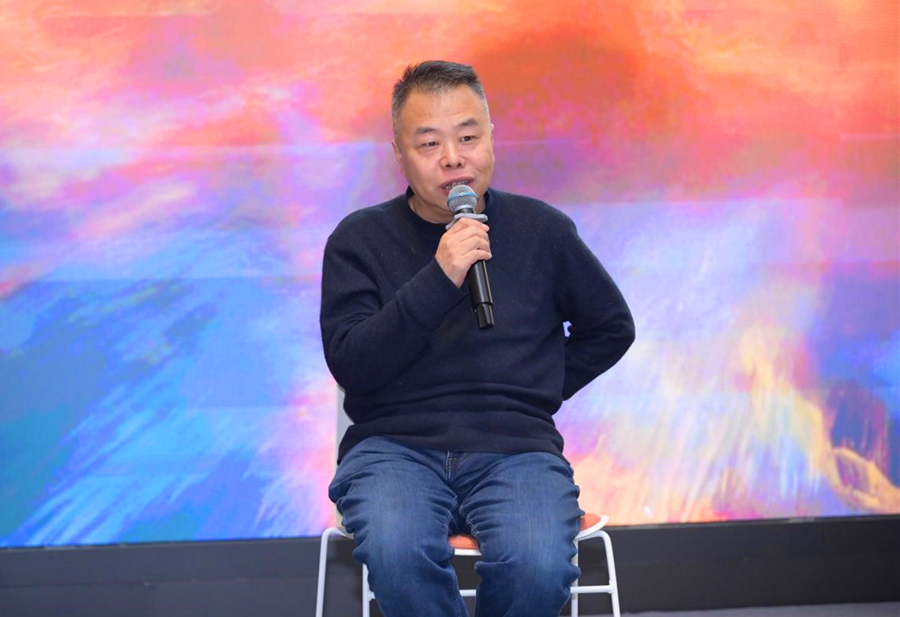
Writer Su Xuejun speaks at a commemorative seminar in Beijing, Feb. 5, 2026. [Photo courtesy of Beijing Yuanyu Science Fiction and Future Technology Research Institute]
Wu Yan, a prominent Chinese sci-fi scholar, writer and professor at the Southern University of Science and Technology, praised Su as a rare writer who embodies "an independent character, unique literary pursuit, pure artistic sensibility and a sense of responsibility to the industry."
He also noted that Su self-funded a magazine during the sci-fi industry's downturn to provide a platform for young writers, a testament to his dedication to the field.
Guests also watched an AI-generated short film based on Su's sci-fi work "Crimson," produced by Liu Jian of Mulan, an AI-powered video creation platform. The short film visualized the narrative with striking imagery, showcasing AI's potential for sci-fi creation.
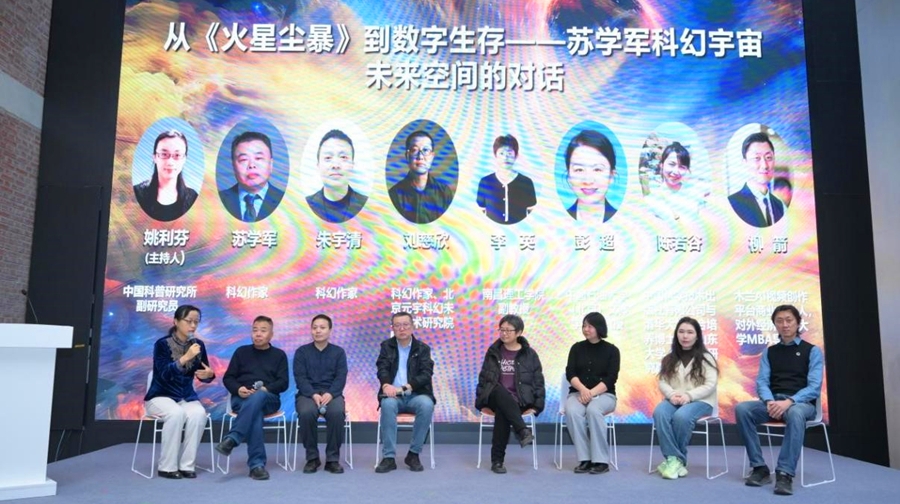
During a roundtable discussion, sci-fi writers including Su, Liu Cixin and Zhu Yuqing, researchers Li Ying, Peng Chao and Chen Ruogu, and Mulan's Liu Jian discussed "From 'Martian Dust Storm' to Digital Existence: A Dialogue on the Future Space of Su Xuejun's Sci-Fi Universe."
Sci-fi luminary Liu Cixin, inspired by Su's work, said future Mars development might involve modifying humans to adapt to extraterrestrial environments. Zhu warned of potential "new alienation" brought by technology and emphasized the resilience of vulnerable communities.
Li, Peng and Chen identified core themes in Su's work: "universe, history, civilization, realism, tradition, the unknown and the perseverance of the insignificant." They praised his epic narrative style that places the inheritance of Chinese civilization against a vast spatial and temporal backdrop.
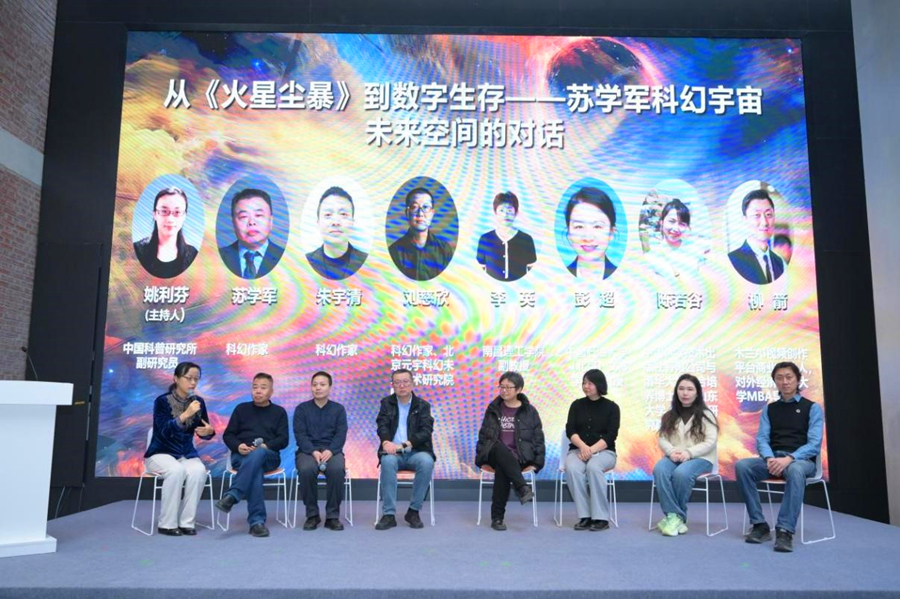
A panel discussing Su Xuejun's classics is held during a commemorative seminar in Beijing, Feb. 5, 2026. [Photo courtesy of Beijing Yuanyu Science Fiction and Future Technology Research Institute]
Liu Jian, also an MBA mentor at the University of International Business and Economics, shared his experience using AI tools to transform text into audiovisual content, describing it as "the second Renaissance in human history."
In contrast, Su expressed ambivalence toward technology, stressing the need to remain vigilant about its risks while cherishing civilization's continuity.
Several fellow sci-fi writers took the stage after the panel to discuss Su's influence, recalling their friendship and professional exchanges. They agreed that the "pioneering spirit of space exploration," the "grand cosmic view" blending myth and sci-fi, and the humanistic depth in Su's works form an indispensable backbone of original Chinese sci-fi.
Liu Cixin again praised Su's role in connecting past and future generations of sci-fi writers, particularly citing works such as "Ancient Stars" and "The Times of Great Antiquity" for their integration of classical Chinese culture with hardcore science fiction.
In his response and to thank everyone for the tributes, Su said he remains highly productive, writing 200,000 to 400,000 words annually, and has a large body of unpublished work. He also noted that sci-fi ideas have shaped developments in smart cities and fire safety regulations, becoming part of the nation's modernization efforts.
The event also introduced the fourth Science Fiction Planet Awards competition. Founders Liu Cixin and Wu Yan took the stage to address what they called "AI anxiety."
Liu suggested that in the short term, AI would struggle to replace human creativity based on real-life experience, but in the long term, technology may fundamentally reshape literature and art.
Asked what kind of entries can stand out, Wu said winning submissions should possess four key qualities: originality, deep integration of science and technology, humanistic value and concise expression suited to contemporary reading habits.
This year's competition is open to global submissions across seven major fields, with the entry deadline set for Feb. 25.
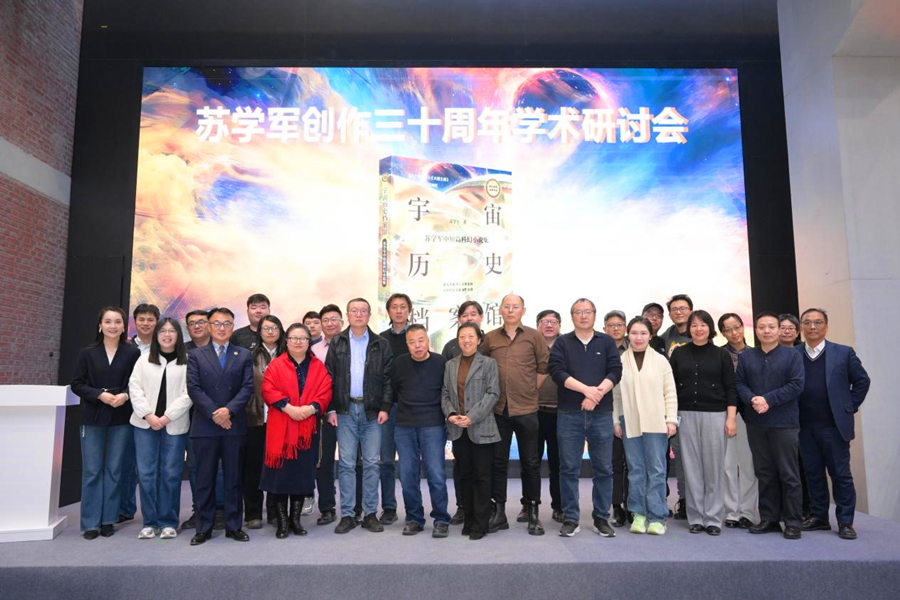
Su Xuejun, organizers and guests pose for a group photo at a commemorative seminar in Beijing on Feb. 5, 2026. [Photo courtesy of Beijing Yuanyu Science Fiction and Future Technology Research Institute]
The seminar served as both a tribute to Su's career and a showcase of Chinese sci-fi's depth and potential. Many guests said they hoped Su would continue contributing to Chinese and global sci-fi literature, enhancing the international influence of Chinese sci-fi.


 京公网安备
11010802027341号
京公网安备
11010802027341号