Share:

As lianhuanhua, China's traditional picture-story books, mark their 100th anniversary, we spoke with Li Jian — one of the country's leading collectors — about the art form's past, present and future.
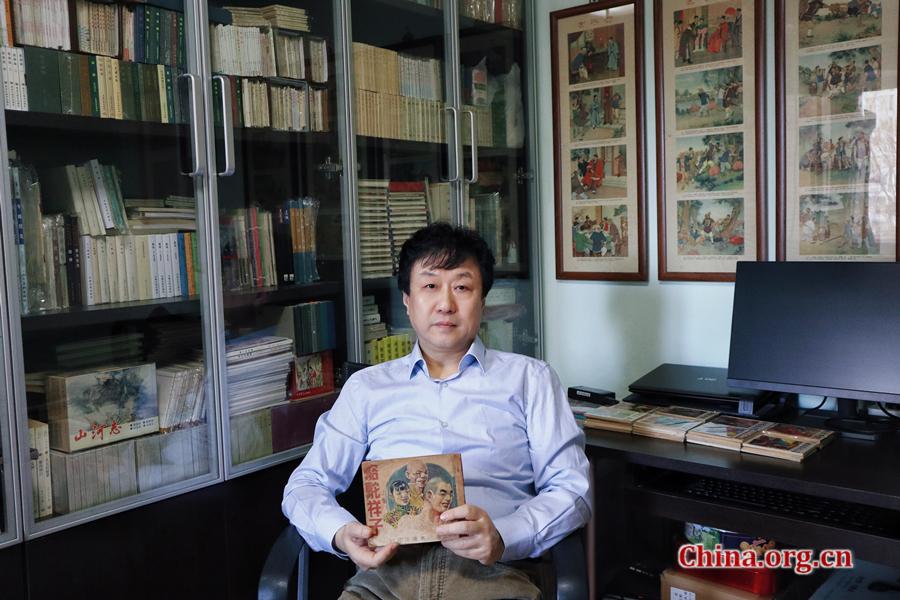
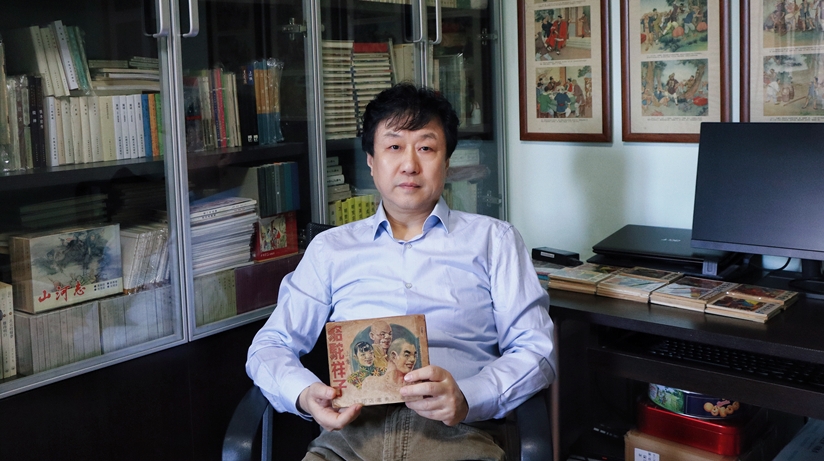
Collector Li Jian among his collection of more than 8,000 volumes of lianhuanhua at home in Beijing, Dec. 27, 2025. [Photo/China.org.cn]
"Many of us once lived in small cities and towns with limited material resources," he said. "Apart from the dreams in our hearts, what comforted our spiritual world were books. There was a kind of book called 'lianhuanhua.' It accompanied the childhood, adolescence and youth of those of us born in the 1960s, '70s and '80s. It was our joy and happiness back then."
Lianhuanhua, also known as xiaorenshu, resemble comic books but are a distinct Chinese picture-story book art form that feature a single drawing on each page with a block of descriptive text beneath. While early sequential paintings date back to the Han dynasty (202 B.C.-A.D.220) — such as those found on a lacquered coffin from Mawangdui Tomb No.1 in Changsha— the first modern publications formally designated as "sequential pictures" were classics like "Romance of the Three Kingdoms" and "Journey to the West," published by Shanghai's World Book in 1925.
The art form flourished in the decades that followed. From the 1950s to the '90s, nearly all renowned Chinese artists — including traditional masters Liu Jiyou, Cheng Shifa and Liu Danzhai, and oil painters Chen Yifei, Chen Danqing and Zhou Chunya — contributed to the creation of lianhuanhua. These books became affordable, accessible reading materials for ordinary households, helping children learn history and classics through engaging storytelling. Soon, these picture-books became the collective memory of generations.
Encompassing every painting style from traditional Chinese ink to oil, watercolor and woodcut, several lianhuanhua works won major awards worldwide. As a key cultural pillar since the founding of the People's Republic of China, they have been woven into the fabric of society for over 70 years, connecting painters and readers across the country.
"Lianhuanhua were books for ordinary people," Li explained. "They depicted the destinies of individuals, the arc of stories and the upheavals of nations. They recorded customs, emotions and conflicts of great eras. The concise texts and picture series captivated our hearts, sparked our imagination and carried our thoughts to ancient times, foreign lands, battlefields and the cosmos."
Over its 100-year history, lianhuanhua has set remarkable records. According to publishers, the 10-volume "Railway Guerrillas" (1955) remains the most reprinted realistic-themed work, with 20 reprints and a total print run of over 36.5 million copies. The 1957 "Romance of the Three Kingdoms" series spans 60 volumes with nearly 7,000 individual drawings, while the 1986-1988 "World Literary Classics" project adapted global works into 15 volumes with 1,300 illustrations. "Stories of Chinese Idioms" involved the largest creative team: 37 writers and 244 illustrators producing 6,356 drawings for 500 idioms. More than 200,000 lianhuanhua titles were published after the founding of the People's Republic of China.
Lianhuanhua have also gained international recognition. The 1953 publication of "The Letter with Feathers" in several languages by the Foreign Languages Press paved the way for global reach, followed by a 1959 gold medal at the Leipzig Book Fair and a featured showcase at an international comics fair in Italy in 1982. Artist Liu Jiyou won the first international award for "Wu Song Fights the Tiger" in 1956 in Moscow, and He Youzhi held the first solo overseas exhibition in the city of Angoulême in France in 1987.
The art form also entered academia in 1980, when the Central Academy of Fine Arts established the country's first lianhuanhua major, with He Youzhi serving as China's first professor of the discipline. Numerous research books have also been published on the topic since the 1950s.
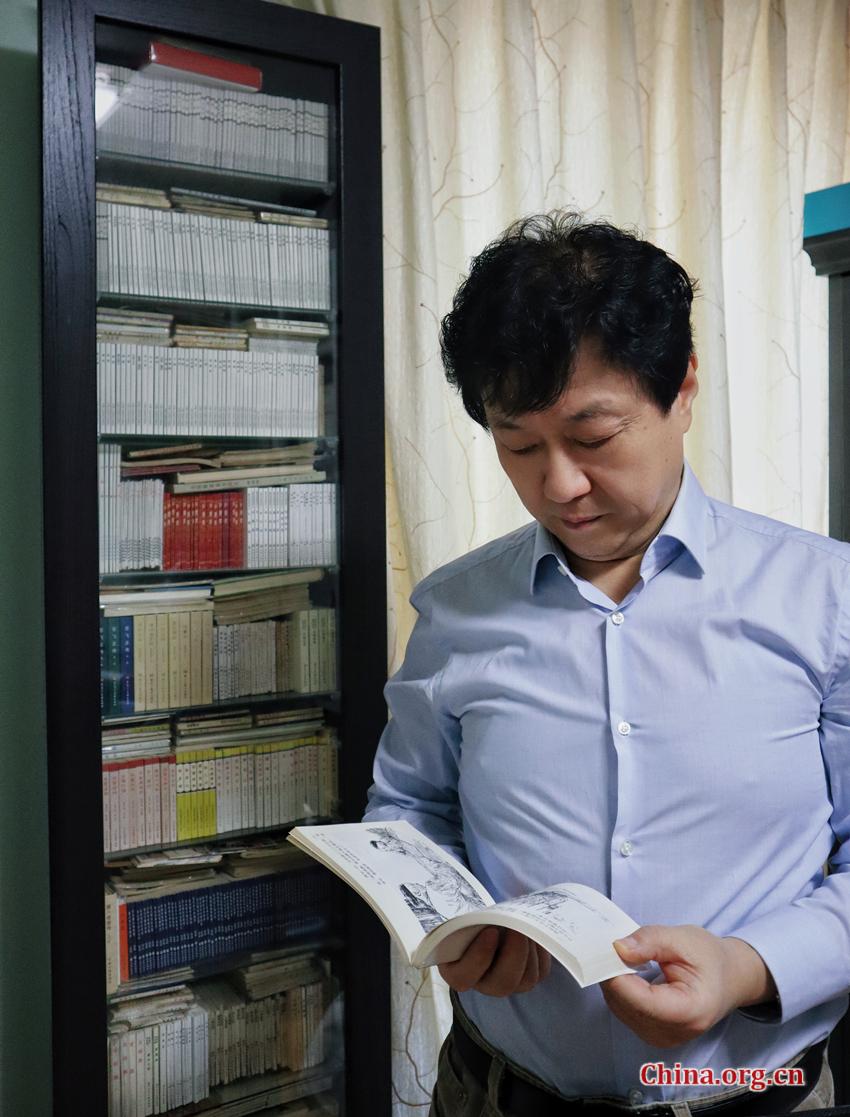
Li Jian examines a lianhuanhua book at his home in Beijing, Dec. 27, 2025. [Photo/China.org.cn]
However, its golden era ended around 1995, as films, cartoons and Japanese anime flooded the Chinese market, displacing lianhuanhua. By the late 1990s, they had transformed into sought-after collector's items, valued for their nostalgic appeal and artistic merit, with currently 500,000 lianhuanhua collectors in China.
"We cannot go back to the heyday, because the modes of appreciation and entertainment have changed," Li said. "Even television, once dominant, has declined. Lianhuanhua can now only serve as a nostalgic tribute to fine art, rather than a medium that people seek for its own sake."
With a personal collection of over 8,000 volumes, Li plans to publish an academic book on lianhuanhua and hold exhibitions across China next year.
"A cultural product that has endured for a century will not be lost to history," he said. "More than 90% of classic works — Chinese and foreign, ancient and modern — have been adapted into lianhuanhua. I think young people will once again take up lianhuanhua reading in the future. In this fast-paced society, reading a novel like 'Les Misérables' takes time, but lianhuanhua offers a condensed illustrated version that helps readers achieve their goals, with images enhancing comprehension. This is highly significant."


 京公网安备
11010802027341号
京公网安备
11010802027341号