


 Share:

The second "Sci-Fi+" Industrial Innovation Salon was held in Beijing's Shijingshan district on Nov. 30, honoring Chinese popular science pioneer Gao Shiqi. The event focused on the convergence of Chinese science fiction and current technology, aiming to provide strong support for the industry's future development.

Gao Shiqi. [Photo courtesy of China Scientists Museum]
As part of the "Never-Ending China Science Fiction Convention" series, the event marked the 120th anniversary of the birth of Gao Shiqi (1905-1988). He is a founding figure of China's popular science field. Qiu Huadong, who is both an author and vice chairman of the China Writers Association, reviewed Gao's creative path of wrapping scientific rigor in literary imagination. He noted works like "The Autobiography of Bacterium" not only established the important position of Chinese popular science literature, but also pioneered the integration of sci-fi and popular science.
"Gao Shiqi used his pen as wings to build a warm bridge between science and the public," said Qiu. "He carried the core of science with humanistic narratives, making science perceptible, relatable and understandable. This spirit is a shared intellectual treasure for all science and technology innovators, popular science communicators and science fiction imaginers today."
Wan Long, district mayor of Shijingshan district, said that Gao's lifelong popular science writing lit the light of science for the public, a spirit that is even more precious in today's era of accelerating life science and future interactive technology development. He pointed out that "Sci-Fi+" is becoming a vital link connecting scientific research breakthroughs, technological innovation and industrial application, serving as a vivid extension of the scientific spirit.
Although Gao Shiqi's son, Gao Zhiqi, could not attend due to illness, he sent a special letter. Chen Liuqi, vice president of the Beijing Yuanyu Science Fiction and Future Technology Research Institute, read the letter aloud. It was an emotional moment when he reviewed Gao Shiqi's inspiring life and detailing how, with era-transcending courage and responsibility, he laid a solid foundation for science popularization in China. He managed all of this despite his physical disability.
Highlights included a presentation by Westlake Therapeutics founder Gao Xiaofei on frontier breakthroughs in life sciences. He analyzed trends from gene editing to AI-powered drug development. He told the attendees the field is entering a new phase driven by the integration of three key forces: model-driven research, computation-driven analysis, and automated experimentation, all of which are set to advance the biomedical industry and public health.
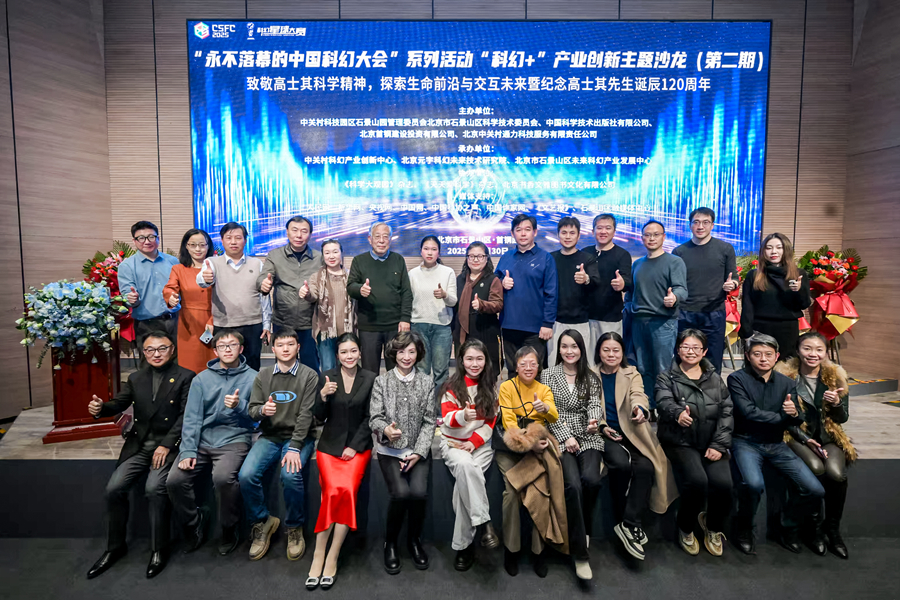
Participants of the second edition of "Sci-Fi+" Industrial Innovation Salon pose for a group photo in Beijing, Nov. 30, 2025. [Photo courtesy of Beijing Yuanyu Science Fiction and Future Technology Research Institute]
The salon also featured two panel discussions. One focused on the frontier breakthroughs and application transformation of life sciences. The other panel examined the interaction between brain-computer technology and literary creation.
During the first panel discussion, renowned science fiction writer Wang Jinkang initiated the conversation with the topic of how science fiction imagination inspires life science, providing thought-provoking insights. Industry representatives and experts then exchanged views on capital support, clinical demand, science communication and technology commercialization. They collectively outlined the key components of a life and health ecosystem. Their intersecting perspectives revealed a cycle where science fiction sparks inspiration, research drives breakthroughs, collaboration speeds application, and public engagement strengthens the ecosystem. This cross-disciplinary dialogue enriched the application scenarios of life sciences, expanding its potential development paths.
During the second panel discussion, experts and high-tech entrepreneurs explained how brain-computer technology is set to transform future creative methods from artistic and communication perspectives. They shared the latest practices in technology research and development, smart health and interaction methods. By discussing medical applications and engineering implementation, they demonstrated the technology's broad prospects in rehabilitation therapy, sensory enhancement and future human-machine symbiosis.
A tribute section concluded the event, where science fiction writers, university professors and guest speakers offered multi-dimensional interpretations of Gao Shiqi's work. Their contributions reinforced a consensus that the scientific spirit is never merely a cold formula; it can be the romance within science fiction, the warmth in human narratives and the driving force for young scholars and experts moving forward.
The event also supports Shijingshan district's goal of leveraging platforms like Shougang Park to build a technology-driven digital innovation hub. Through various policies supporting R&D, original content creation, scenario application and talent attraction, the district is deepening the integration of key sectors like sci-fi, gaming and esports, as well as virtual reality, all to accelerate its distinctive regional future industry ecosystem.

New set of Gao Shiqi's children's sci-fi books are published. [Image courtesy of Popular Science Press]
Shijingshan has emerged as Beijing's sci-fi industry hub in recent years, hosting 236 enterprises that generated 15.3 billion yuan ($2.1 billion) in revenue during 2024. It accounts for nearly one-third of the city's total sci-fi sector revenue.


 京公网安备
11010802027341号
京公网安备
11010802027341号