


 Share:

The Golden Rooster film market hosted its first international roundtable event on Nov. 12, bringing together international filmmakers with leading figures and young creators from China's film industry to explore collaborative channels for Chinese films going global.

(Left to right) Host Zhang Fan, international producers Pedro Barbadillo, Natacha Devillers and Michael Auret take part in a panel discussion during the 2025 China Golden Rooster and Hundred Flowers Film Festival in Xiamen, Fujian province, Nov. 12, 2025. [Photo/China.org.cn]
The filmmakers, film fund representatives, producers and programmers from countries including Spain, France, the United Kingdom and South Africa, joined Chinese filmmakers at the film market section, known as GRIFF Industry. Together, they explored two topics: "From pitch to profit: investment, incentives and international markets" and "Why them? Cracking the code to the global stage for Chinese films."
The Sino-French production "Moon the Panda," directed by Gilles de Maistre and starring renowned Chinese actor Liu Ye alongside his two children, tells the story of a 12-year-old boy and his fractured family of five who find healing through a wild panda cub he names Moon.
"This coproduction project with China is actually quite complex, particularly at the content level," revealed producer Natacha Devillers. "The cultural DNA of a coproduction largely depends on the director's perspective. If led by a Chinese director, the work naturally roots itself in Chinese culture, with market focus and financing primarily leaning toward China. However, if directed by a foreign filmmaker, even if filmed in China, the work remains fundamentally closer to a Western film. Therefore, it's essential to clarify the cultural positioning before embarking on a coproduction."
Facing the different demands of Eastern and Western markets, Devillers shared: "Rather than pursuing complex content, it's better to focus on telling a theme that resonates." She highlighted that the creation of documentaries and animations typically involved less complex cultural and linguistic content, resulting in fewer obstacles in collaboration.
China and France are exploring coproduction models through projects like "The Lost City of Sanxingdui," a collaboration between China Media Group (CMG) and France Télévisions that demonstrates a breakthrough in cultural storytelling. Director Pascal Cuissot, who specializes in making films on ancient civilizations, explained that he always seeks common human ground. "Fundamentally, we share similar cultural DNA. Both China and France have long histories, with people loving their countries and valuing historical cultures," he said.
"China boasts a massive audience and strong technological innovation, which holds great appeal for us," said Pedro Barbadillo, documentary director, producer and founder of The Slate, a film fund from Spain, during the roundtable discussion. He acknowledged that finding subjects capable of crossing cultural boundaries and adapting to diverse markets is key to the success of Sino-Spanish coproductions. "For me personally, collaborating with the Chinese market not only means accessing new financing channels but also opens up entirely new narrative possibilities and technological innovation perspectives," he said.
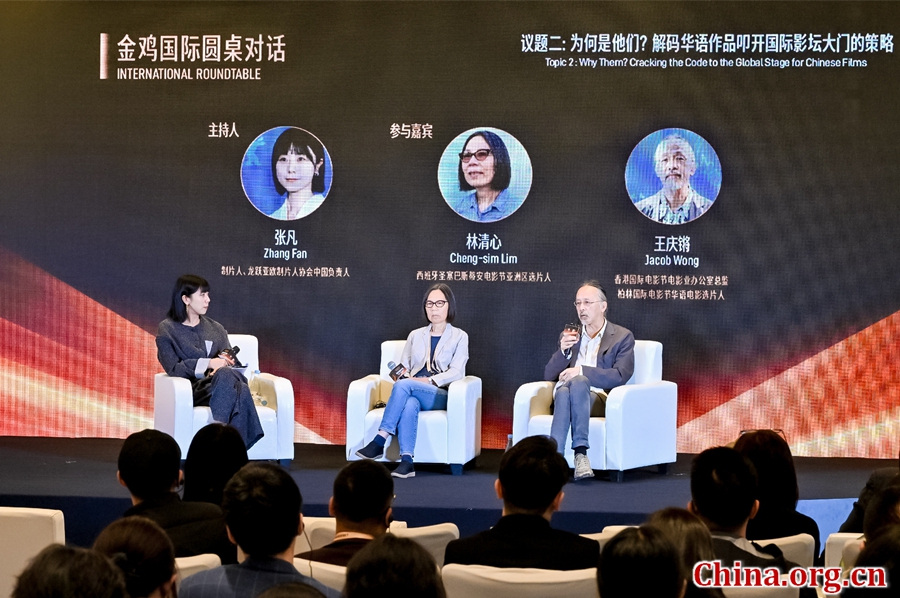
(Left to right) Host Zhang Fan, film curators Cheng-sim Lim and Jacob Wong take part in a panel discussion during the 2025 China Golden Rooster and Hundred Flowers Film Festival in Xiamen, Fujian province, Nov. 12, 2025. [Photo/China.org.cn]
Focusing on strategies for helping Chinese-language films break into the international film arena, dialogue guests Jacob Wong, director of the Hong Kong International Film Festival Industry Office and delegate for Chinese-language cinemas at the Berlin International Film Festival, and Cheng-sim Lim, filmmaker and film curator for the San Sebastián International Film Festival, shared their professional perspectives.
"Good films can change how you see the world, and such works are encountered rather than sought," Wong said. Regarding the core question of what constitutes a "good film," he offered a poetic criterion: "It's like love — you know it when you encounter it. There's no fixed formula for a good film, but it's about how to use the language of cinema to tell a story well."
Jacob Wong noted that while the Berlin International Film Festival's selection committee reviews over 3,000 films annually, only about 80 Chinese-language submissions were received this year. Despite this intense competition, he observed remarkable resilience among Chinese filmmakers.
Wong stressed that technical quality, including sound, color grading and music, is crucial for international festival submissions since selection committees often watch films in suboptimal conditions. Meanwhile, Lim advised submitting well before the deadlines, noting that last-minute entries face significantly lower selection rates.
The participants also discussed technologies such as streaming platforms and artificial intelligence, and their impact on the film industry's international promotion and distribution.
"We must admit that streaming media did cause widespread concern among traditional filmmakers at the beginning, but today it has become an indispensable channel for film promotion," Barbadillo said. "Initially, streaming platforms showed film clips and summaries, which did affect our box office revenue. However, on the other hand, many audiences discovered the appeal of films through these platforms and subsequently went to cinemas."
The application of AI was another hot topic. Producer Michael Auret, who now manages the Spier Film Fund, maintained a cautious stance. "I'm experimenting with using AI to reduce costs for short films," he explained, "but in feature film creation, AI cannot replace the warmth of human touch."


 京公网安备
11010802027341号
京公网安备
11010802027341号