


 Share:

The National Art Museum of China (NAMOC) in Beijing is hosting an exhibition of zisha, or purple clay, teapots crafted by Wang Qiang from Oct.15-28, as part of the museum's effort to discover and support artistic talent.

Zisha teapots on display in ceramic artist Wang Qiang's solo exhibition at the National Art Museum of China in Beijing, running from Oct. 15-28, 2025. [Photo by Liu Sitong/China.org.cn]
With a history dating back to the Song dynasty (960-1279), zisha teapots are a unique type of non-glazed ceramic ware highly sought after by Chinese tea lovers.
Made from a rare type of clay discovered in Yixing, Jiangsu province, zisha ware reinforces the amora of tea and can be designed into various shapes to fulfill diverse aesthetic aspirations. With a quality between pottery and china, its simple texture and muted elegance quietly attract a large number of devotees.
Born into a family of ceramic artisans in 1981 in Yixing, the cradle of zisha teapot making, Wang Qiang has been steeped in the appreciation of zisha ware since a young age.
He learned from master zisha teapot makers, while also studying arts and crafts such as painting and seal cutting that he uses to enhance the aesthetic value of the ware. In 2014, he went to Tsinghua University's Academy of Arts and Design to study ceramic design and later gained a master's degree.
In recent years, Wang has been focusing on combining refined craftsmanship with his thoughts on history and cultural heritage while innovating the art in a contemporary context.
For this NAMOC exhibition, he brought dozens of items for display with the theme of steelyard weight, called "chengtuo" in Chinese, a measuring tool that symbolizes China's profound history and continuous civilization. Indeed, unified weights and measures are a token of efficient and effective governance of a country.
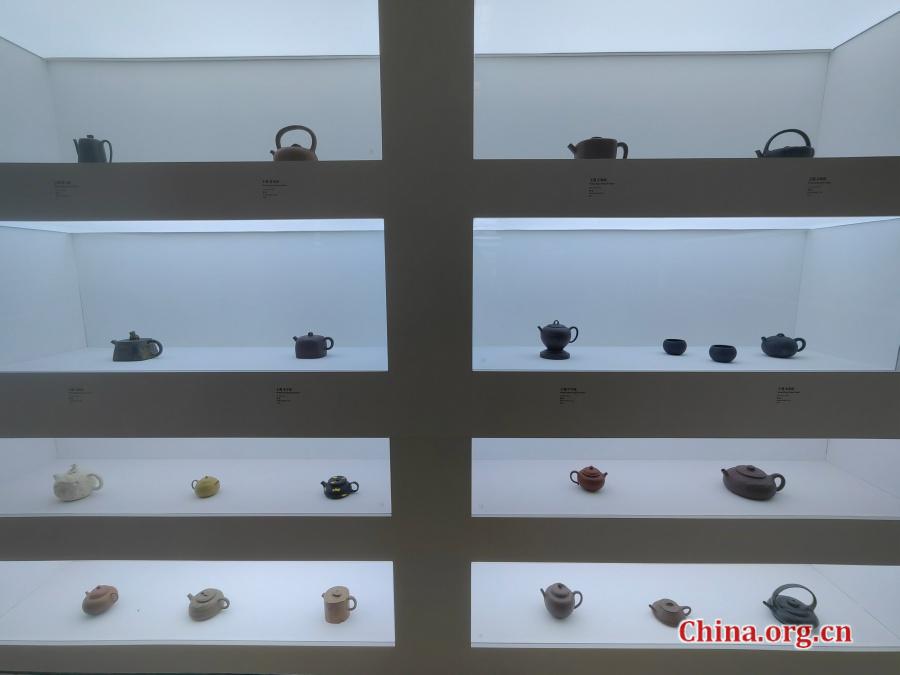
Zisha teapots on display in ceramic artist Wang Qiang's solo exhibition at the National Art Museum of China in Beijing, running from Oct. 15-28, 2025. [Photo by Liu Sitong/China.org.cn]
The shapes of the teapots have been designed to resemble those of steelyard weights. Meanwhile, Wang engraved the reign titles of different emperors and important eras and dynasties throughout Chinese history on the surface of the teapots and used them as the titles of the pieces.
For example, one teapot is titled "Weight of Yongle," referring to the reign title of Emperor Zhu Di of Ming dynasty (1368-1644) who sent Zheng He on epic ocean voyages to bridge different cultures and ordered the compilation of the Yongle Encyclopedia to aggregate ancient books and records for future generations to inherit.
The Qin dynasty (221-207 B.C.) is prominently featured in the exhibition, with several teapots related to the period. While the dynasty was short, it is of paramount importance in Chinese history.
Its first emperor, Qinshihuang, ended the Warring States period (475-221 B.C.), united the country and issued an imperial decree to unify weights and measures, which is inscribed on teapots' surface to accentuate this historical milestone.
The late Qing dynasty (1616-1911) and the Republic of China period (1912-1949) are also highlighted.
One teapot is named "Year of Gengzi" (1900) after the year that the Eight-Nation Alliance invaded China. Other pieces include "Weight of the Republic of China," and "Awakened Lion of China," a metaphor referring to the rise of the Chinese nation amid a tumultuous time.
A lineage of Chinese history is clearly demonstrated with this lineup of reign titles and historical moments featured on the weight-shaped teapots, which seem to measure the gains and losses of different dynasties and encourage the exhibition goers to consider the ups and downs of the past.
The production of zisha teapots requires dozens of processes such as shaping, mounting, carving, polishing and decorating. Wang has developed his techniques over the years and has been innovating and trying to breathe new life into this cultural heritage, which was listed as a national intangible cultural heritage in 2006.
For the exhibits on display, a variety of materials including bronze, iron, jade, stone and agate have been mixed with the zisha to create rich textures, tactile impressions and visual effects, while marks of patina, wear and tear and mottled patterns add an sense of antiquity and suit the nostalgic ambience of the history-inspired theme.


 京公网安备
11010802027341号
京公网安备
11010802027341号