 Share:

The draft outline of the 15th Five-Year Plan (2026-30) identified intelligent-connected new energy vehicles (NEVs) as one of the emerging industries China plans to prioritize, underscoring the sector's growing role in the country's push toward a more technologically advanced economy.
For the auto industry, this means turning cars into intelligent agents capable of perception, interaction and decision-making in complex physical environments.
He Xiaopeng, chairman and CEO of XPeng and a deputy to the National People's Congress, described this trend as the rise of "physical AI." He defined the concept as the integration of AI capabilities with mobile hardware, and said intelligent vehicles and robots are among the most practical real-world applications for such technology.
XPeng recently unveiled its second-generation Vision-Language-Action model and a Robotaxi, part of a broader industry effort to build shared AI capabilities across vehicles and robotics.
He said he expects NEVs to evolve into cars with far more advanced AI capabilities over the next five to 10 years, while robots will move from remote-controlled machines toward fully autonomous systems capable of motion, control and decision-making.
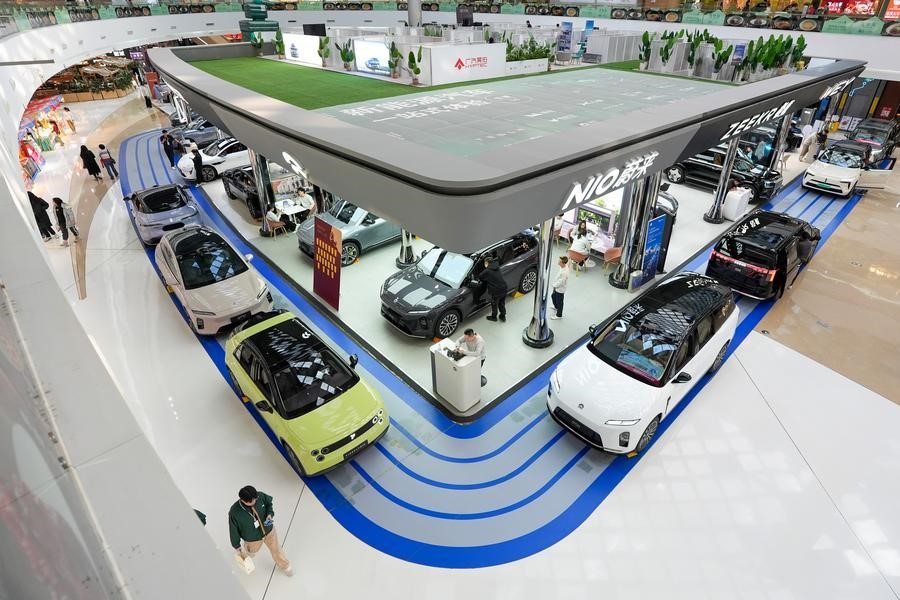
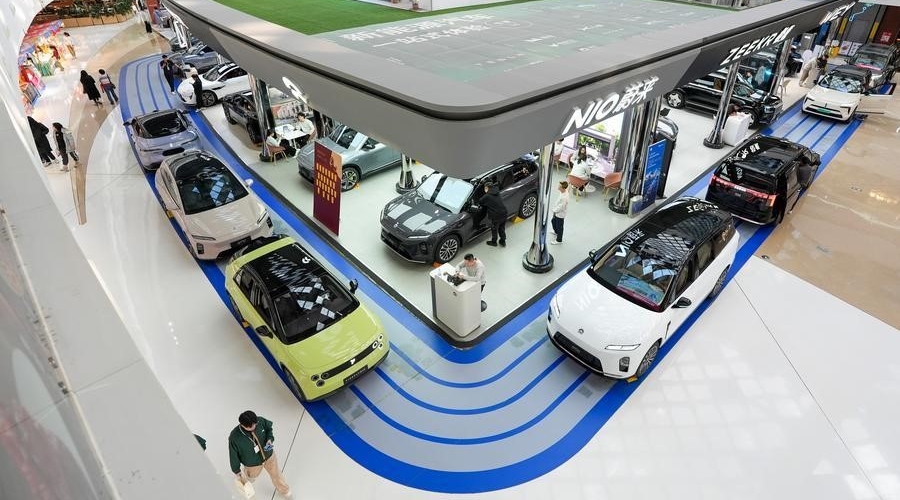
People view new energy vehicles at a shopping mall in Chaoyang district of Beijing, capital of China, Feb. 11, 2026. [Photo/Xinhua]
However, turning this vision into large-scale adoption will require more than advances in algorithms. Yang Yongxiu, an NPC deputy from the front line of automobile manufacturing, said more needs to be done on vehicle-road-cloud integration, self-reliance in key core technologies, and cross-industry collaboration.
Yang called for benchmark pilot projects, unified industry standards and stronger policy support, while stressing the need to develop skilled talent through closer ties between industry and education and clearer career pathways.
Another challenge lies in the vehicle's own hardware architecture. As autonomous driving, smart cockpits and electrification generate ever-greater volumes of data, traditional in-vehicle copper wiring is approaching its limits in bandwidth, weight and electromagnetic compatibility.
NPC deputy Liu Wu, an optical communications expert, said "fiber in vehicles" is becoming an important direction as Level 3 autonomous driving scales up.
He said onboard optical communication offers advantages including high bandwidth, low latency, lighter weight and resistance to electromagnetic interference, and could help support the next generation of intelligent-connected vehicles.
These proposals reflect how far the intelligent-connected NEV sector has evolved beyond a single automotive segment. Its development now touches vehicle manufacturing, regulation, communications technology, infrastructure and workforce training.
With stronger policy support and continued technological progress, intelligent-connected NEVs could become both a platform for real-world AI application and one of the clearest examples of how China seeks to translate emerging technologies into industrial strength and new growth drivers.


 京公网安备
11010802027341号
京公网安备
11010802027341号